Stock and costs
Recipe yields: costing food that changes when you cook it
Write recipes in the unit you actually serve — cooked cups, cut pieces — while stock keeps counting in the unit you buy. Set the yield once and every cost, deduction and report follows it.
6 min read · Updated September 2, 2026
You buy rice by the kilo. You serve it by the cup. And a cup of cooked rice is not a cup of raw rice — it is a fraction of one, because rice roughly triples when it takes on water.
So when you write the recipe for Chicken Rice, what do you put? Before yields the
only honest answer was to do the arithmetic yourself, once, on paper, and type
the result: 0.08 kg. It works. But nobody who opens that recipe later can tell
whether 0.08 is right, where it came from, or what it was supposed to represent.
Change your serving size and you have to redo the sum for every dish that uses
rice.
A yield moves that arithmetic into the app. You tell it once how much cooked rice a kilo makes, and from then on you write recipes the way you actually cook.
What a yield is
One sentence: one of the unit I buy makes this many of the unit I serve.
One kilo of rice makes 12.5 cooked cups. One whole chicken makes 8 cut pieces. One bag of charcoal makes the kilos you portion out of it. The ingredient is still stocked, counted and costed in the unit you buy — the yield only gives you a second name for a slice of it.
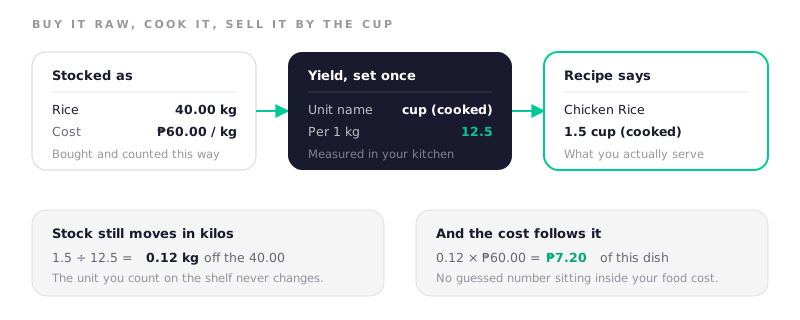
Nothing about your stock changes. You still buy 40 kg, count 40 kg, and see 40 kg on the Inventory page. The recipe simply stops needing you to speak kilos.
Set one up
Go to Inventory, open the item — or add a new one — and find the Yield section under the unit picker. It is optional, and most ingredients never need one.
Pick the unit first. Until you do, the section has nothing to count from and says so, because "per 1 ___" has no meaning yet.
Then fill in two fields:
- Unit name — what you want to call it in recipes.
cup (cooked),piece (cut),scoop,ladle. Your words; nobody else has to read them. - Per 1 kg — how many of those one stocked unit produces. The label follows whatever unit you chose, so it might read Per 1 pcs or Per 1 bags.
Tap Add yield for another one. An ingredient can have several — rice sold by the cup for one dish and by the ladle for another is two yields on one item.
If you name an ingredient something with "rice" in it, a suggestion appears offering 12.5 cups per kg. It is a starting point, not a fact about your kitchen: tap it to fill the row, then correct it to your own number.
Use it in a recipe
Go to Menu, open the product, and open its recipe. Each line has Item, Qty and Unit — and the Unit dropdown now lists your yield units beside the physical ones.
So the rice line becomes 1.5 cup (cooked) instead of 0.08 kg. That is the
whole feature. The recipe now says what the cook does.
What it changes downstream
Everything, quietly, and all in the same direction — the yield is applied wherever a recipe quantity is read:
| Where | What you see |
|---|---|
| A sale | Stock comes off in the stocked unit. 1.5 cooked cups deducts 0.12 kg. |
| Food cost | The recipe dialog costs the line at the stocked unit's cost — 0.12 kg × ₱60.00 = ₱7.20. |
| A void | Credits back exactly what the sale took, so the round trip nets to zero. |
| Product waste | A wasted dish writes off its recipe quantities, converted the same way. |
| Usage reports | Daily usage, ingredient usage and fast/slow movers all read the converted figure. |
That consistency is the point. A recipe line written in a serving unit but read as a raw quantity anywhere would be wrong by the whole yield factor — twelve times over, in the rice example.
It is not only weight and volume
Yields were once restricted to kg and liters, on the reasoning that a piece cannot become more pieces. Cutting is exactly that:
- 1 whole chicken → 8 cut pieces. Stocked in
pcs, served inpiece (cut). A recipe for one serving deducts 0.125 of a chicken. - 1 bag → 25 kg. Stocked in
bags, portioned in kg. - 1 tray → 30 eggs.
Any stocked unit can carry a yield, because the only thing the conversion needs is a number to divide by.
Getting the number right
Measure it once, properly, and it is yours forever. Cook a kilo the way your kitchen actually cooks it and count what comes out — your rice, your pot, your water ratio, your scoop. A number from the internet describes somebody else's kitchen.
Two habits worth keeping:
- Re-measure when something changes — a new supplier, a different variety, a new scoop. The yield is a fact about your process, and processes drift.
- Check it against reality monthly. If the recipes say you used 30 kg of rice and a physical count says 34, either the yield is optimistic or there is wastage nobody recorded. Both are worth knowing, and they need different fixes.
Frequently asked questions
Do I have to use yields?
No. Most ingredients are bought and used in the same unit — a sachet is a sachet. Add a yield only where the raw form and the served form are genuinely different things, which in practice means rice, anything portioned from a whole, and anything you cook down.
Does a yield change my stock count?
Never. Stock is always held, counted and displayed in the unit you buy. The yield only translates recipe quantities on their way in. Your Inventory page reads the same before and after you add one.
What if my yield is wrong?
Your food cost is wrong in the same proportion, and your stock deducts too little or too much on every sale of that dish. It is worth ten minutes with a measuring cup. Fixing it later is just editing the number — recipes written against it update automatically, because they store the serving unit, not the converted figure.
Can I use a yield unit when reporting waste?
For a whole dish, yes — wasting a cooked portion writes off its recipe lines, converted exactly as a sale would be. Writing off a raw ingredient directly asks for the quantity in that ingredient's stocked unit, because at that point you are counting what is physically on the shelf.
Why is the suggestion 12.5 cups per kilo?
It is a common figure for long-grain rice cooked at a normal water ratio, offered only as somewhere to start. It is never applied on its own — you have to tap it, and you can edit it the moment it lands.
Can one ingredient have more than one yield?
Yes, and it is the normal case for rice: a cup (cooked) for rice meals and a
ladle for silog plates, both against the same kilo. Each recipe line picks the
unit that suits it.
Next: suppliers and restocking.