How to run a pop-up food stall at a weekend market and actually make money
October 12, 2026 · Jott Myth · 11 min read
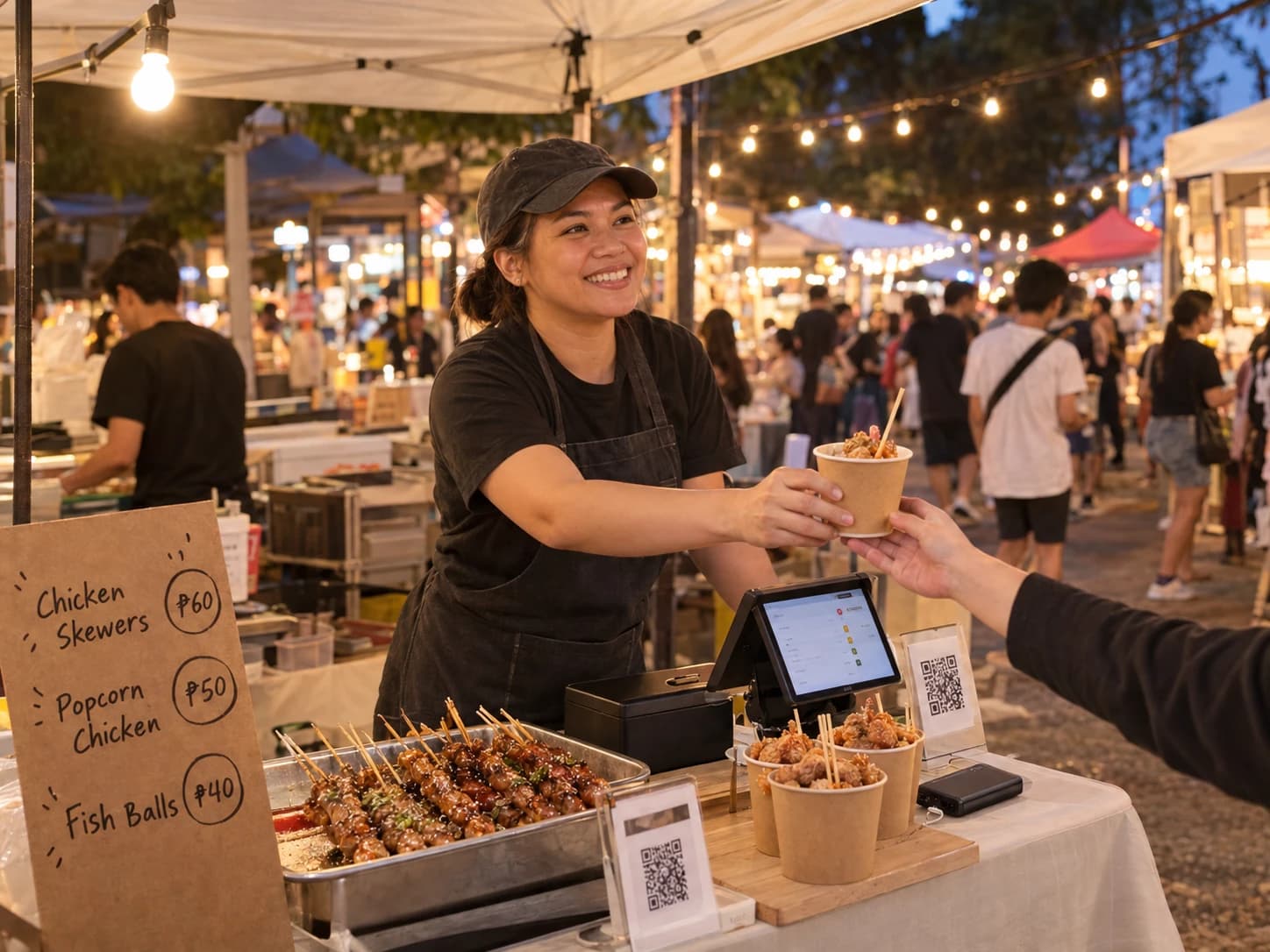
In short: a pop-up stall makes money when one night's sales cover that night's costs and leave something over, so work out your break-even before you pay the stall fee. Sell three to five fast, hand-held items. Bring more stock than you expect to sell. Make sure your till works without a signal.
Weekend food markets are where a lot of food businesses start. Manila has Mercato Centrale and Banchetto. Most cities have their own night market, food bazaar or Sunday market. You pay for a few square metres, cook for one crowd for a few hours, and go home. No lease, no landlord, no year-long bet.
That is also why it is easy to lose money without noticing. The stall fee, the helper, the ice and the ride there are all paid before the first customer turns up. A busy table can still lose money.
How do you make money with a pop-up food stall?
A pop-up food stall makes money when one night's sales, after ingredients and packaging, cover that night's stall fee, helper, transport and ice, with something left over. Work out that break-even number before you book. Then sell a short menu of fast, hand-held food, bring enough stock not to sell out early, and use a till that works offline.
People run pop-ups for three different reasons, and it helps to know which one is yours:
- As the business itself. The market is the shop, and the stall has to make a profit every weekend.
- As a second outlet. You already have a shop and the market brings in customers who would never walk past it.
- As a test. You want to know if people will pay for your food before you sign a lease.
The arithmetic below is the same for all three. Only the question you are answering changes.
How much does it cost to run a market stall?
Split the costs into two piles. One-off costs buy things you keep. Per-night costs come back every time you set up.
| Cost | Type | Example |
|---|---|---|
| Tent, table, cooler, sign | One-off | $300 |
| Stall fee | Per night | $150 |
| A helper for the night | Per night | $40 |
| Transport there and back | Per night | $25 |
| Ice and cooking gas | Per night | $15 |
| Total per night | $230 |
Then there is the food itself. Say your hero item sells for $6, and the ingredients plus the cup, lid and napkin cost $2.10. That is 35% of the price, and it leaves $3.90 from every sale to pay the $230.
Prices for stalls vary a lot by city and by market. Ask the organiser for the real fee, including any cut of your sales, before you plan anything else.
How many sales do I need to break even at a pop-up?
Divide the per-night costs by what each sale leaves after its ingredients.
$230 ÷ $3.90 = 59 sales just to cover the night.
On a six-hour market night, from 6pm to midnight, that is about 10 sales an hour before you make a cent. If you can only cook six an hour, you have a problem no amount of foot traffic will fix.
Every sale after the 59th is profit. Sell 150 and the night looks like this:
- 150 × $3.90 = $585 left after ingredients
- $585 − $230 = $355 for the night
Two nights like that is $710 for the weekend, and the $300 of equipment is paid off by Saturday. Your own time is not in those numbers yet, so decide what you think a night of your work is worth before calling $355 a good one.
The free break-even calculator does the same sum. Enter one night's costs as the monthly costs and set the days open to 1, and it gives you the sales you need for that night. Its guide explains each box.
What should I sell at a pop-up stall?
A market crowd walks, looks, and decides in seconds. The menu has to work for that.
- Three to five items, one of them the hero. A long menu slows the queue and splits your prep across too many ingredients. The hero item is the one on the sign and the one most people buy.
- Food you can hand over in under a minute. Finish it to order, but have it mostly ready. Anything that needs ten minutes of cooking caps how many sales you can make in a night.
- Something people eat while walking. A cup, a stick, a wrap or a box with a fork. If it needs a table, most of the crowd will walk past.
- Round prices. $6, not $5.95. Coins slow every sale and you will run out of them by 9pm.
- Something they cannot get every day. People come to markets to try things. Your shop's best-seller might not be the market's.
How much stock should I bring to a market?
More than you think you will sell, especially the first few times.
Look at what each mistake costs. An unsold portion costs you its ingredients, $2.10. A customer you turn away because you sold out costs you the $3.90 that sale would have left. Running out is the more expensive mistake, and a stall that sells out at 9pm on a busy night has thrown away its best three hours.
A practical approach:
- First night: bring about twice your break-even of the hero item. In the example, that is around 120 portions.
- Prep in parts. Keep components that last, like sauces, dry mixes and frozen items, separate from what you finish on the spot. What you do not use can go back to your kitchen.
- Write down when each item sells out. If the hero item is gone by 10pm, bring more next week. If you are throwing half of something away, bring less or cut it.
How do I take payments at a market stall?
Most customers will pay cash, and many will want to pay by phone or card. A market makes both harder.
- Cash: start with a float of small notes and enough coins for your prices. Count it before you open.
- E-wallets, QR and card: take whatever your customers use. A crowd of thousands of phones in one car park can slow or kill mobile data, so have a printed QR code for e-wallets and expect some payments to confirm late.
- Power: a phone or tablet running all night needs a power bank. Ask the organiser if there is a socket, but do not count on it.
Your till should not stop working when the signal does. A notebook till falls apart in a rush, and a till that needs the internet stops at the worst moment.
How do I set up Kasenso for a pop-up stall?
Kasenso is free and runs on the phone or tablet you already have, so the same account can run a market stall or a shop with a stall on weekends.
- Make a market menu. Put the market items in their own category so they sit on one tab of the till. See set up your menu and recipes.
- Give each item a recipe. Link the ingredients and the packaging, so every sale takes them off your stock and shows what each item really costs. See track inventory and stock levels.
- Add your payment methods. Add your e-wallet, card or bank transfer alongside cash, so each sale records how it was paid. See currency and payment methods.
- Sign in before you leave home. The till keeps selling without a connection and uploads orders when the signal comes back. A fresh sign-in still needs a connection, so do it before you go. See work offline.
- Run each market night as one shift. Start the shift with the float you counted. At close, count the cash, and Kasenso tells you whether the drawer matches the sales. See start and close a shift.
- Record the stall fee as an expense. Use a category such as Market fees, so the night's profit includes what it cost to be there. See track expenses.
- Print receipts only if you need to. On the Android app a small Bluetooth printer works without a connection. See receipts and printing. Many market stalls skip printed receipts entirely.
After a few weekends, your sales reports show which items earned their space on the menu, and the peak hours in Analytics show when to have two people cooking instead of one.
What do Mercato Centrale and Banchetto teach a new stall?
Two of Manila's best-known food markets show what running a stall at someone else's market is like.
- The crowd decides the menu. Banchetto began around 2007 as a Friday-night food market in Ortigas Center. Its first crowd was people working night shifts nearby, so the hours and the food fitted them.
- Markets move. Banchetto left its first street in 2011. Mercato Centrale
has changed sites in Bonifacio Global City more than once since it opened in
- Your regulars follow the market, not your stall, so put your social media handle on the sign and tell people where you will be next.
- Plans change overnight. Mercato Centrale closed in March 2020 and came back months later as an outdoor takeout market. Do not tie up money you cannot get back on a market you do not control.
Is a pop-up a good way to test a food business?
Yes. It may be the cheapest test there is. A month of weekend markets tells you which items people buy, what they will pay, and how fast you can cook, without a lease. Track every night the same way, so the numbers are real if you later start a shop.
A good sign is a stall that clears its break-even before 9pm most nights and has regulars asking where you will be next week. A bad one is a stall that is busy every weekend and still only breaks even. That one needs a price check before it needs a bigger market.
Frequently asked questions
What is a pop-up food stall?
A pop-up food stall is a temporary food stand at a market, festival or event. It sells for a few hours, often on weekends or at night, and packs up when the event ends. There is no lease, so it is a low-cost way to sell food or test a menu before opening a permanent shop.
How much does it cost to run a stall at a weekend market?
It depends on the market. A typical night includes a stall fee, a helper, transport, ice and gas. In a worked example those come to $230 a night, plus about $300 once for a tent, table, cooler and sign. Always ask the organiser whether they also take a share of your sales.
How many sales do I need to break even at a pop-up?
Divide the night's costs by what each sale leaves after ingredients and packaging. With $230 of costs and an item that sells for $6 and costs $2.10 to make, each sale leaves $3.90, so you need 59 sales to break even. Every sale after that is profit.
What food sells best at a night market?
Food people can eat while walking, handed over in under a minute, at a round price. Keep the menu to three to five items with one hero item on the sign. Something people cannot easily get every day draws more interest than your shop's usual best-seller.
How much stock should I bring to a pop-up?
Bring more than you expect to sell, around twice your break-even of the hero item for a first night. Running out usually costs more than leftovers: each missed sale loses its profit, while an unsold portion loses only its ingredients. Note when each item sells out and adjust next week.
Can I take card and e-wallet payments at a market with bad signal?
Yes, if you plan for it. Keep a printed QR code for e-wallets and expect some confirmations to arrive late. Use a till that keeps working offline. Kasenso holds orders on the device and uploads them when the connection returns, but sign in before you leave home.
Is a pop-up stall a good way to test a food business?
Yes. A month of weekend markets shows which items sell, what people will pay and how fast you can cook, without signing a lease. Record every night the same way, with sales, costs and the stall fee, so the numbers can tell you whether a permanent shop would work.