High revenue, but losing money — how a busy shop goes negative without noticing
October 9, 2026 · Jott Myth · 8 min read
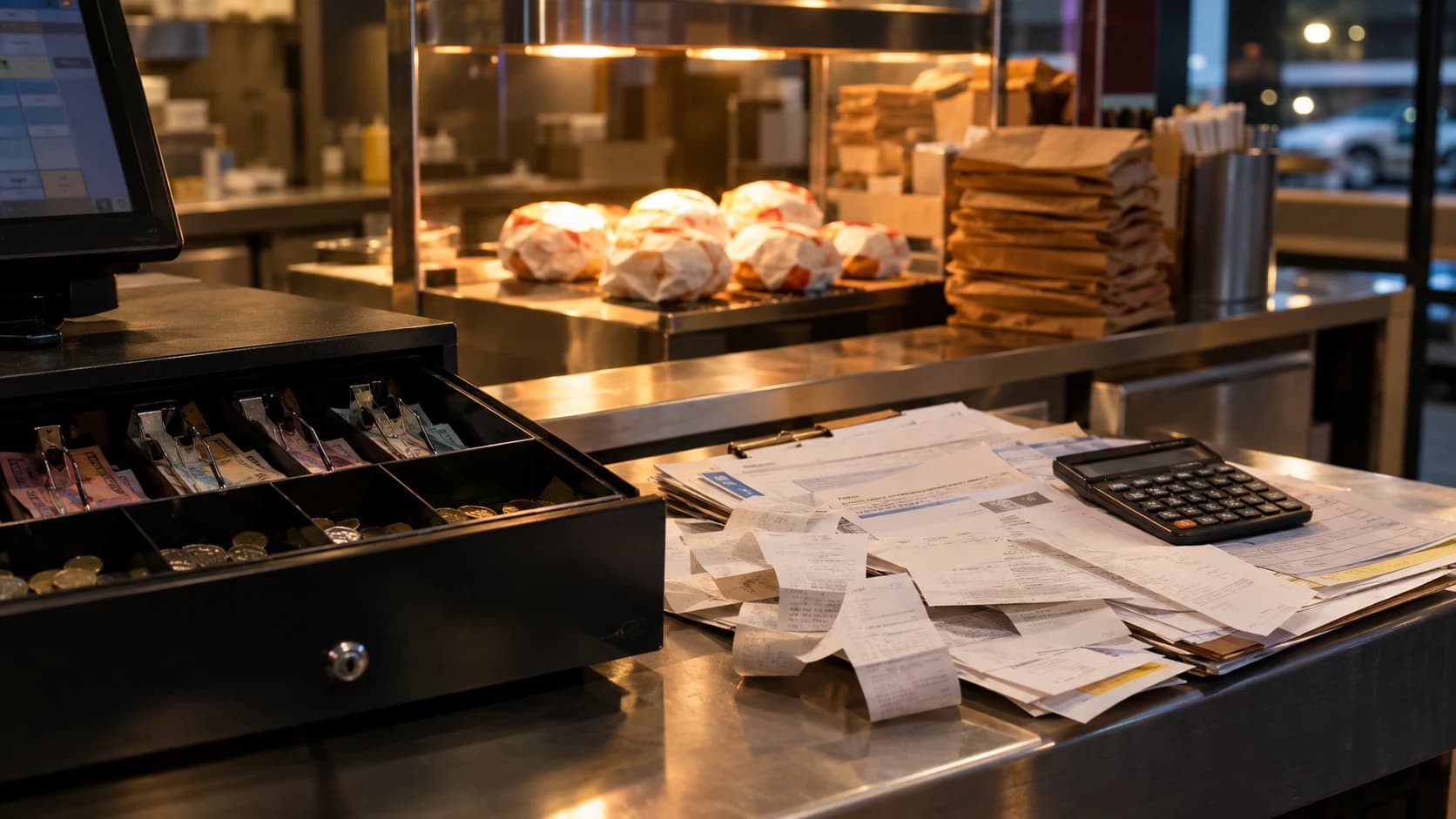
Daniel's burger shop was the busiest on its street. There was a queue at lunch, delivery orders kept coming until late, and on a good Saturday he would take more than $2,000. When friends asked how business was going, he said "really good", and he believed it.
Eight months in, he was paying his main supplier late and putting gas on his personal credit card. He couldn't explain why. The shop was full every day.
Daniel is a composite. His numbers come from a pattern that shows up again and again in small food businesses, and nothing in his story is unusual. That is the point of telling it.
Can a business have high revenue and still lose money?
Yes, and it is common. Revenue is everything customers pay you. Profit is what is left after you pay for ingredients, packaging, staff, rent, utilities, fees and waste. A shop can take in $39,000 a month and still lose $3,000 if its costs come to $42,000. A busy counter tells you about revenue. It tells you nothing about profit.
What Daniel thought he was earning
Daniel kept score the way most owners without a POS do: he looked at the cash drawer at closing and at his bank app now and then.
- About $1,500 a day in sales, 26 days a month: roughly $39,000.
- His double burger sold for $9.50, and when he set that price the ingredients cost about $3.80. In his head every burger made him close to $6.
- Rent, wages and the bills felt like they were "covered easily" by a turnover that size.
Every one of those beliefs was true once. None of them was true eight months later, and he had no way of seeing that.
What the month actually looked like
When Daniel finally sat down with every invoice, payslip, bill and delivery payout for one month, this is what he found:
| Amount | |
|---|---|
| Revenue (everything customers paid) | $39,000 |
| Ingredients and packaging (42% of sales) | −$16,380 |
| Wages, four staff | −$12,000 |
| Rent | −$5,500 |
| Delivery app commission (30% on the quarter of sales that came through the app) | −$2,925 |
| Electricity, gas and water | −$2,900 |
| Food thrown away, never written down | −$1,200 |
| Equipment loan repayment | −$800 |
| Card payment fees (2.5% on the 40% of sales paid by card) | −$390 |
| Total costs | −$42,095 |
| Profit | −$3,095 |
The shop was losing about $3,095 a month, roughly $119 for every day it opened. That figure doesn't include a cent of pay for Daniel, who was working the grill six days a week.
Why he couldn't see it
None of these costs was hidden on purpose. They were hidden because of when and how they arrived.
- Sales arrive every day. Costs arrive in lumps. The drawer fills up daily. Rent leaves once a month, wages every two weeks, the gas bill whenever it turns up. A full drawer on Friday feels like profit, but most of it already belongs to bills that haven't arrived yet.
- Supplier prices crept up without telling him. Beef, buns, cheese and oil each rose a little over eight months. His $3.80 burger now cost $4.90 to make, and his price was still $9.50.
- Delivery payouts arrived with the commission already taken out. He never saw the 30% leave. He just got a smaller deposit and counted it as "delivery sales".
- Waste never sends a bill. Burgers dropped, patties overcooked, buns gone stale, staff meals. $1,200 a month went in the bin without ever appearing on paper.
- He priced from memory. The "$6 a burger" figure in his head was from the week he opened.
The burger that lost money on every delivery
The worst surprise was his best seller. Here is one double burger, sold through the delivery app, at today's costs:
| Per burger | |
|---|---|
| Price | $9.50 |
| Ingredients | −$4.90 |
| Box, bag and sauce cup | −$0.60 |
| App commission (30% of $9.50) | −$2.85 |
| Left over | $1.15 |
That $1.15 has to pay its share of rent, wages and the gas bill before any of it is profit, and it can't. Delivery was the fastest-growing part of Daniel's business, so the busier he got, the more he lost. More orders made the hole deeper.
How do you know if your busy shop is actually profitable?
Take your own month and subtract every cost from revenue, not just the ingredients. The minimum you need:
- Total revenue for the month, from every channel: counter, delivery, card and cash.
- The real cost of each product, ingredients and packaging, at what you pay your supplier today.
- Every fixed cost: rent, wages, utilities, loan repayments, subscriptions.
- Fees taken by card terminals and delivery apps.
- Waste, written down when it happens rather than guessed at the end of the week.
If you have to dig through a drawer of receipts to get any of those numbers, you won't do it every month, and the numbers will drift the way Daniel's did.
What Daniel changed
Once the numbers were in front of him, the fixes weren't dramatic:
- Raised the double burger to $10.50 at the counter and $12.00 on the delivery app, so the app's commission was covered by the delivery price instead of coming out of his share.
- Cut one part-time shift on the two slowest afternoons, saving about $1,100 a month.
- Started writing waste down when it happened. Seeing the number made the kitchen more careful, and waste fell by about half, roughly $600 a month.
He also checked his supplier prices against his menu prices every month instead of once a year. Within two months, the same busy shop was making money.
Where a POS does the tracking for you
Daniel's problem wasn't arithmetic. It was that nobody was keeping the numbers up to date. That is the job worth handing to a POS.
- Recipes. Enter each item's ingredients and packaging once. Every sale then deducts them, so the cost and profit of each item stay current when your supplier's prices change.
- Expenses. Enter rent, wages and bills as recurring expenses once, and they are counted in every period they run. That is what turns your sales figure into a real profit figure.
- Reports. Business Performance works down from what customers paid to what you kept, line by line. It also splits sales by dine-in, takeout and delivery, and by payment method.
- Waste. Recording wastage takes about ten seconds per event and puts the cost in your reports instead of the bin.
- Trends. Analytics plots revenue and profit side by side for twelve months. "Revenue up, profit flat" is exactly Daniel's pattern, and you can see it there months before it reaches your bank account.
If you want to know how many sales a day your shop needs just to cover its costs, what your day costs before you sell anything walks through that number step by step.
Kasenso is free: orders, recipes, inventory, expenses and reports, for any shop anywhere.
Frequently asked questions
What is the difference between revenue and profit?
Revenue is the total money customers pay you. Profit is what remains after every cost is paid: ingredients, packaging, wages, rent, utilities, fees and waste. A shop with $39,000 in monthly revenue and $42,095 in costs has a loss of $3,095, even though it looks busy every day.
Why does my business feel busy but I never have money?
Usually because costs have grown faster than prices. Supplier prices creep up, delivery apps take a commission before paying you, waste goes unrecorded, and fixed bills arrive in lumps that a full cash drawer hides. The only way to find the gap is to subtract every cost from revenue for a whole month.
How do delivery apps affect my profit?
A delivery app commission of around 30% comes straight out of the price. On a $9.50 burger that costs $5.50 to make and pack, a 30% commission leaves $1.15, which is too little to pay a share of rent and wages. Many shops set a higher price on the app to cover the commission.
How often should I check my profit?
At least once a month, and every time a supplier changes a price. Cost changes build up slowly, and a menu priced a year ago can be losing money today. A POS that records costs with each sale lets you check your profit any day instead of waiting for month end.
Can a POS tell me if I am losing money?
Yes, if it tracks costs as well as sales. Kasenso records each item's ingredient and packaging cost through recipes, counts recurring expenses such as rent and wages, and records waste. Its reports then show gross profit, operating profit and net profit, so a loss is visible on screen rather than in your bank account.
How much does it cost to track sales and profit with Kasenso?
Nothing. Kasenso's free plan includes orders, recipes, inventory, expenses and profit reports, for any shop in any country. It is a full plan, not a trial that turns into a subscription.