How to price your menu so you actually make money
August 12, 2026 · Jott Myth · 3 min read
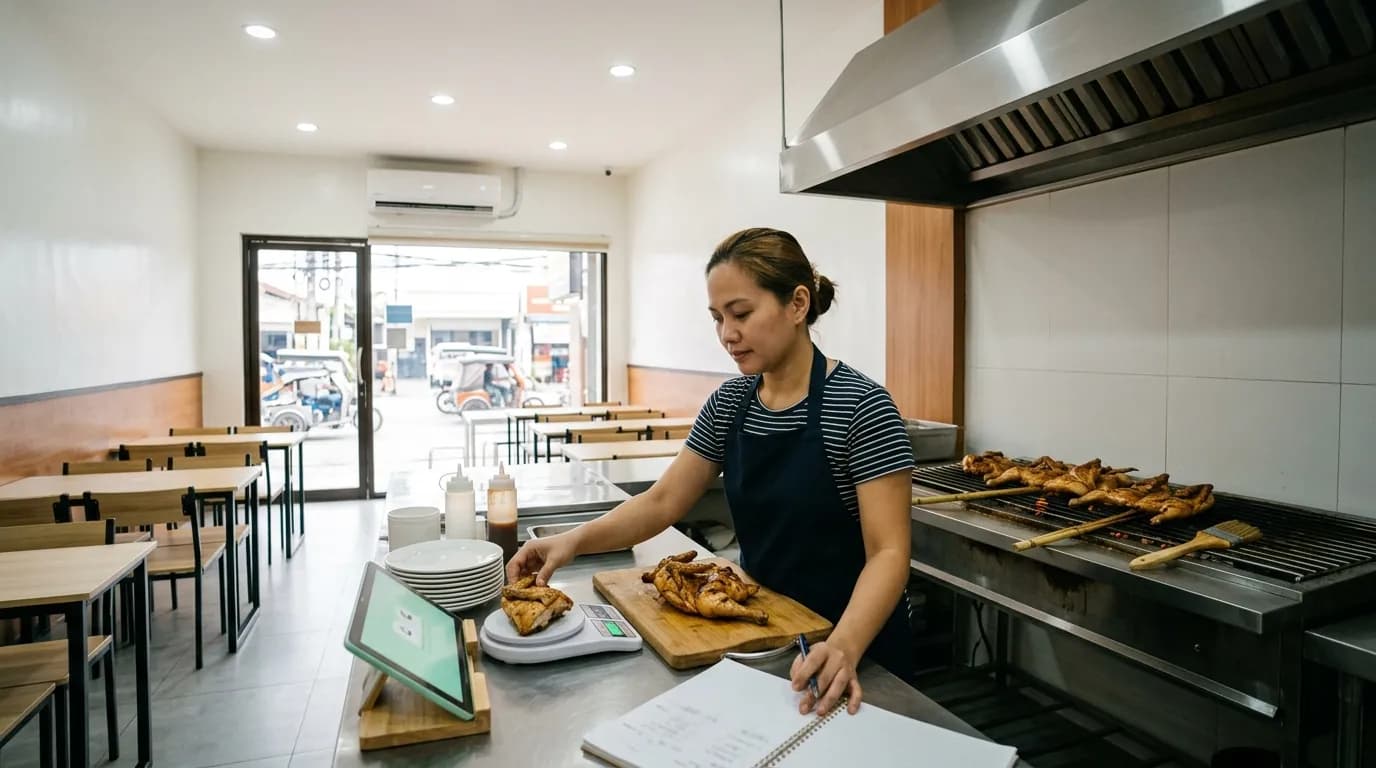
Ask a shop owner how they set their prices and the honest answer is usually "the place down the street charges ₱150, so we charge ₱145." It feels safe. It is also how a business sells more every month and still ends up with less money in the bank.
The fix is not complicated. It is one number per dish, and most people have never worked it out.
Start with what the plate actually costs
Your food cost is the total cost of every ingredient in one serving — including the things nobody bothers to count. The chicken, yes. Also the oil it was fried in, the sauce, the rice, the cup, the lid, the straw, and the plastic bag it left in.
Take a single serving of fried chicken with rice:
| Item | Cost |
|---|---|
| Chicken (250g) | ₱62.00 |
| Marinade & breading | ₱8.50 |
| Cooking oil (per serving) | ₱6.00 |
| Rice (1 cup) | ₱9.00 |
| Sauce sachet | ₱3.50 |
| Container, lid, bag, utensils | ₱11.00 |
| Total food cost | ₱100.00 |
That last row is the number that matters, and the packaging line is the one people forget. Eleven pesos sounds like nothing until you sell two hundred plates a week — that is ₱2,200 a week of "nothing."
Then apply a food cost percentage
The rule of thumb across food service is that ingredients should be about 30–35% of the menu price. Divide, don't multiply:
Menu price = food cost ÷ 0.33
For our ₱100 plate, that is ₱303 — call it ₱299. If that number made you wince, that reaction is the useful part. It means one of three things is true:
- Your portion is too big for the price you want to charge.
- You are buying badly and your ingredient costs are too high.
- The dish genuinely does not work at your target price, and it is costing you money on every single order.
All three are worth knowing. None of them are visible if you price by looking next door.
Why the other 67% is not profit
The gap between food cost and menu price is not margin. It is everything else: rent, electricity, gas, wages, delivery commissions, breakage, and the meals that get sent back. A 30% food cost is not a target because it makes you rich — it is roughly what it takes to survive once the rest is paid.
This is also why delivery apps hurt so much. A 20% commission does not come out of your profit, it comes out of that 67%, and there is a lot less slack in it than owners expect.
Check it against the real world, then decide
Once you have the arithmetic, then look at the shop down the street. If they sell the same plate at ₱145 and your maths says ₱299, they are doing something you are not: smaller portions, cheaper supply, cheaper packaging, or losing money and not knowing it. Any of those is possible. Find out which before you match their price.
Where a POS helps
None of this is hard. It is just tedious, and it goes stale the moment a supplier raises prices.
That is the part worth automating. In Kasenso, you enter a recipe once — the ingredients and quantities that make up a dish, including packaging — and every sale deducts them from inventory automatically. When your chicken supplier raises prices, you update one ingredient and every dish using it recalculates.
You stop guessing at food cost, and you find out a dish stopped being profitable in the same week it happened rather than at the end of the year.
Setting that up takes about twenty minutes. There is a step-by-step guide if you want to work through it.