How to start a small shop: what to decide, in what order, and when to open
October 7, 2026 · Jott Myth · 16 min read
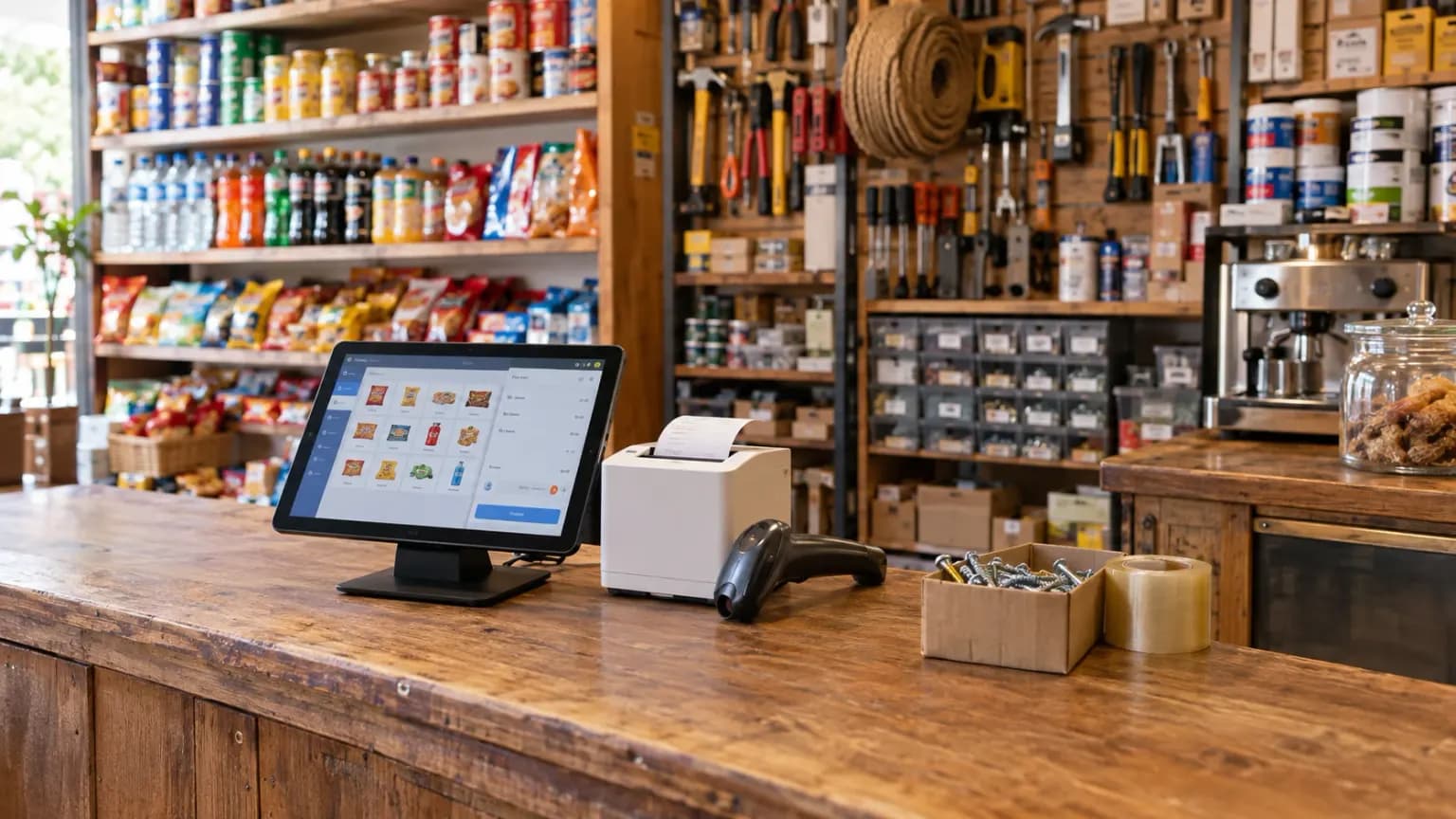
Most people who open a shop do it in the order things come to mind: find a space, buy stock, open, and work out the numbers later. The numbers arrive anyway, usually in the third month, when the savings are gone and the shelves still look full.
This post puts the decisions in the order that saves money. It works for a café or food stall, and just as well for a corner shop, a general store or a hardware store — the steps are the same, and only a few of the answers change.
How do you start a small shop?
Start with the numbers, not the space. Decide what you will sell and to whom, add up what opening costs and what each month costs, and work out the sales you need each day to cover it. Only then sign a lease, choose suppliers, buy opening stock, set up a till, and open quietly before you open loudly.
In order:
- Decide what you sell, and who buys it
- Add up what it costs to open
- Add up what each month costs, and the daily sales that cover it
- Find the place
- Register the business and sort out the paperwork
- Choose suppliers and buy opening stock
- Price everything
- Set up the till, the hardware and your staff
- Soft-open, fix what breaks, then open properly
What kind of shop are you opening?
This is the decision that shapes everything after it, including what kind of point-of-sale system you need. Small shops fall into three shapes:
| You… | Examples | Stock is counted in | Cost of an item is |
|---|---|---|---|
| Make what you sell | Café, food stall, bakery, restaurant | Ingredients: kilos, litres, pieces | The sum of its recipe |
| Resell what you buy | Corner shop, general store, hardware store | The products themselves | What you paid for it |
| Do both | Café with bags of beans and mugs, canteen with a grocery shelf, hardware store with a coffee counter | Some ingredients, some products | Depends on the item |
A hardware store sells the same box of screws it bought. A café sells a latte that did not exist until someone made it. Most real shops are a little of both: a general store with a hot food counter, a bakery with a drinks fridge. Know which one you are before you choose suppliers, shelving or software.
Then be specific about the customer. "Everyone in the neighbourhood" is not a customer. "Builders and handymen who need fixings before 7 am", "office workers who want lunch in under five minutes" and "families who need milk, bread and eggs at 9 pm" are. The customer tells you your opening hours, your stock and your prices.
How much money do you need to start a shop?
Less than people fear for the equipment, and more than people expect for everything else. A worked example for a small corner shop, in US dollars:
| Cost | Corner shop example |
|---|---|
| Deposit and first month's rent | $2,400 |
| Shelving, counter, fridge | $3,000 |
| Signage and fit-out | $1,000 |
| Licences, registration, first insurance payment | $600 |
| Opening stock | $6,000 |
| Till hardware: tablet, receipt printer, barcode scanner | $350 |
| Cash for the drawer (the float) | $200 |
| Opening total | $13,550 |
| Reserve: three months of running costs | $7,500 |
| What to have ready | $21,050 |
The figures are placeholders — rent alone can be ten times this in one city and a tenth of it in another. The shape is what matters: stock and rent are the big lines, the till is a small one, and the reserve is as large as the fit-out.
The reserve is the line people skip, and the one that closes shops. Sales take weeks to build. A shop that opens with its last dollar spent on stock has no way to survive a quiet second month.
How much do you need to sell each day to break even?
Add up everything you pay each month whether or not you sell anything — rent, wages, electricity, internet, insurance — then divide by the share of each sale you keep after paying for the goods. That gives your monthly break-even sales. Divide by the days you open.
For the same corner shop:
- Monthly running costs: $1,200 rent + $1,000 wages + $300 electricity and internet + $0 till software = $2,500
- On average, goods cost 75% of the price you sell them for, so you keep 25% of each sale
- Break-even sales: $2,500 ÷ 0.25 = $10,000 a month
- Open 30 days: $10,000 ÷ 30 = $333 a day
Every dollar of sales above $333 a day is profit; every dollar below is coming out of the reserve. If the number looks impossible for the street you have in mind, it is far cheaper to find out now than after you sign. The free break-even calculator does this arithmetic for you — see how to use it.
A café keeps a bigger share of each sale than a corner shop, often 65–70% rather than 25%, but has higher wages and more waste. For the full version of this sum for a food business, see what your day costs before you sell anything.
How do you choose a location?
Count people before you sign anything. Stand outside the place at the hours you plan to open, on a weekday and a weekend, and count who walks past and who looks like your customer. Then check three things:
- Can your break-even number happen here? At $333 a day and an average basket of $8, you need about 42 customers a day. Did you see 42 of your customers walk past in an hour, or in a day?
- Who already sells it nearby? A competitor is not a reason to walk away — it proves demand — but you need a reason to be chosen instead: longer hours, a better range, trade accounts, faster service.
- Can deliveries reach you? A hardware store receiving cement and timber needs somewhere for a truck to stop.
What paperwork do you need to open a shop?
It depends on your country and city, so ask your local council, city hall or business registration office before you sign a lease — some premises cannot be licensed for food at all. Most places need:
- A business registration and a tax registration
- A permit or licence to trade from those premises
- A food safety or health permit if you prepare or sell food
- Insurance for the premises and the stock
- A way to keep sales records, since the tax office will ask
Put the permit dates in your plan. A health inspection booked for three weeks after your planned opening is your real opening date.
How much opening stock should you buy?
Enough to look full, not enough to last a season. New shop owners overbuy because empty shelves feel like failure, then discover which half of the stock actually sells.
- Corner shop and general store: start with the 20% of products that make most of the sales anywhere — drinks, snacks, bread, milk, eggs, cleaning basics — and add from what customers ask for.
- Hardware store: fixings, tape, glue, basic tools, electrical and plumbing fittings first. Bulky slow sellers like timber or large tools can be ordered in for a customer before you stock them.
- Café or food stall: a short menu. Eight items you make well beat thirty you make sometimes, and every extra dish is another set of ingredients waiting to spoil.
Write down what customers ask for that you do not have. After a month, that list is your next order.
How should you price what you sell?
For goods you resell, start from what you paid and decide the share you keep. A box of screws that costs you $3.00, sold at $4.00, keeps $1.00 — 25% of the price. For food, add up the recipe and price from that; see how to price your menu and margin vs markup before you set a single price.
Two things are easy to forget:
- Your cost price moves. When the next delivery of screws costs $3.50 a box, your $4.00 price now keeps only $0.50. Your till should tell you that, not your accountant at the end of the year.
- Regulars may need a different price. A hardware store's builders and contractors expect a trade price and often a monthly tab. Decide your rules before the first one asks.
What hardware do you need for a small shop?
Less than the shop-fitting brochures suggest. For one counter:
| Hardware | What it does | Do you need it? |
|---|---|---|
| Tablet or Android phone | Runs the till | Yes — a 10-inch tablet is the most comfortable |
| Tablet stand | Keeps it at the right height, and harder to walk off with | Recommended |
| 58mm or 80mm Bluetooth thermal printer | Prints receipts and kitchen tickets | Only if you print; receipts can be sent instead |
| USB or Bluetooth barcode scanner | Adds an item to the sale in one scan | For a shop with many packaged goods; the tablet's camera works to start with |
| Cash box or drawer | Holds the float | Yes, if you take cash |
| Card terminal | Takes card payments | Whatever your bank or payment provider offers |
For a corner shop or hardware store, the scanner earns its price fastest. A cashier who can scan a basket of twelve items does not have to find twelve tiles on a screen, and nobody types a price wrong.
Avoid hardware that only works with one till system, and long contracts on equipment you could buy outright. A shop's first year is when cash is tightest.
What point-of-sale system does a small shop need?
One that matches the shape of the shop. A food business needs recipes that take ingredients off stock, sizes and add-ons, and a way to get orders to the kitchen — why a restaurant needs a restaurant POS goes through why. A corner shop, general store or hardware store needs the opposite: products that keep their own stock count, barcode scanning, restocks that update the cost price, and often trade customers on account. A shop that does both needs both, in one till.
Before you choose, ask any POS seller to show you:
- Can it count stock the way my shop works — ingredients, products, or both in one sale?
- Does a restock update what each item costs me, so my profit figures stay true?
- Can I scan barcodes, and add my own codes for goods that have none?
- Can I sell by the metre or the kilo — chain, rope, loose nails, flour?
- Can a regular customer pay later on account, with a credit limit?
- Does it keep selling when the internet drops?
- Does it run on a tablet or phone I already own, and what does it cost per month, per device and per staff member?
Kasenso now runs retail shops as well as food
Kasenso started as a POS for small food businesses, and it now sets itself up for whichever of the three shapes your shop is. At sign-up, under What do you sell?, you choose:
- Food & drinks — recipes take ingredients off stock, with sizes and add-ons, dine-in, takeout and delivery, and a kitchen display.
- Retail goods — for a corner shop, general store or hardware store. Each product keeps its own stock count, with a cost price, SKU and barcode.
- Food & retail — each product is either Made here, from a recipe, or Sold as bought, with its own count. A latte, a bag of beans and a mug can go through in one sale.
For a retail shop, that means:
- Barcode scanning with a USB or Bluetooth scanner, or the tablet's camera.
- Restocks re-average the cost price: 40 boxes at $3.00 plus 60 boxes bought for $210 makes 100 boxes at $3.30, and every sale after that is costed at $3.30.
- Selling by measure: type 2.3 for 2.3 metres of chain at $1.15 a metre, and the stock, the line and the receipt all use it.
- Importing products from a spreadsheet, so a general store's 800 lines do not have to be typed one by one.
- Customer accounts and trade prices, for builders who pay at the end of the month.
All of it is set out in the retail guide and customer accounts. It runs in a browser or the Android app, keeps selling offline, prints to 58mm and 80mm Bluetooth printers, and you can change what you sell later under Settings → What You Sell without losing anything.
When should you open?
Open twice. A soft opening first: a week or two with no announcement, short hours, and friends, neighbours and the people who stopped to ask what you were building. You will find out that the printer runs out of paper at the worst moment, that the price tag on the paint is wrong, and that nobody can find the light switches at closing. Fix it while the queue is short.
Then the proper opening, when the till works, the shelves are right and you are ready to be busy. A few things decide the date:
- Every permit is in hand. Not applied for — granted.
- Your stock has arrived and is in the till. Every product with a price, and every count entered, so the first day's sales start from true numbers.
- The timing suits your customers. Open a hardware store before the season when people fix their houses, not after it. Open a café when offices are back from holiday, not during it. Payday weekends are busier than the week before them.
- You have practised. Ring up twenty test sales, void one, close a shift, count the drawer. Doing it on day one with a queue is how mistakes happen.
The first month after you open
Look at three numbers every evening, and nothing else until they make sense:
- Sales against break-even. $333 a day in the example. Above it, below it, and is the gap closing?
- What sold, and what didn't. Reorder the first, stop buying the second.
- Does the cash drawer match the till? A drawer that is $20 short every day is $600 a month. See why your cash drawer never balances.
Frequently asked questions
What is the first step to starting a small shop?
Decide what you will sell and to whom, then add up what opening costs and what each month costs. From that, work out the daily sales you need to break even. Only sign a lease once you know that number is realistic for the location you have in mind.
How much money do you need to open a small shop?
It depends on rent and stock in your area, but plan for the fit-out, opening stock, licences, a cash float, till hardware and a reserve of three months of running costs. In the corner shop example, opening costs are $13,550 and the reserve brings it to about $21,000.
How do you work out how much a shop needs to sell each day?
Add your monthly running costs, divide by the share of each sale you keep after paying for the goods, then divide by the days you open. $2,500 a month ÷ 0.25 is $10,000 a month, and $10,000 ÷ 30 days is $333 a day.
When is the best time to open a new shop?
When every permit is granted, stock is in and priced, and staff have practised on the till. Hold a quiet soft opening for a week or two first, then open properly at a time that suits your customers, such as before the building season for a hardware store.
What hardware does a small shop need?
A tablet or Android phone to run the till, a cash drawer if you take cash, and a card terminal from your bank or payment provider. A 58mm or 80mm Bluetooth receipt printer and a barcode scanner are optional; a corner shop or hardware store gets the most from the scanner.
Do I need a barcode scanner for a corner shop?
Not on day one. Kasenso can scan barcodes with the tablet or phone's camera. Once the counter gets busy, a USB or Bluetooth scanner that acts as a keyboard is faster, reads in poor light, and needs no special setup to work with Kasenso.
Can Kasenso be used by a hardware store or general store?
Yes. Choose Retail goods at sign-up or under Settings → What You Sell. Each product keeps its own stock count with a cost price, SKU and barcode, and Kasenso supports barcode scanning, selling by the metre or kilo, spreadsheet import, trade prices and customer accounts.
Can one shop sell food and retail goods in Kasenso?
Yes. Choose Food & retail. Each product is either Made here, using a recipe that takes ingredients off stock, or Sold as bought, with its own stock count. One sale can mix both, and only the made items go to the kitchen display.
How much does a POS cost for a small shop?
Kasenso is free, with no card, contract or per-device fee, and runs on a tablet or phone you already own. Your real till cost is the hardware: a tablet, and optionally a Bluetooth receipt printer and a barcode scanner.
The short version
Do the arithmetic before you sign anything, keep three months of running costs in reserve, buy less opening stock than feels right, and match your till to the shape of your shop. Whether you are opening a café, a corner shop or a hardware store, Kasenso is free to set up today on the tablet or phone you already have — see pricing for what is included.