Why your cash drawer never balances
August 27, 2026 · Jott Myth · 6 min read

You count the drawer at closing, the number is ₱180 lower than it should be, and a thought arrives that you do not enjoy having about people you work with every day.
Put it down for a moment. In small food businesses, a drawer that does not balance is a process problem far more often than a people problem. The gap is information, and it usually has a boring explanation — but only if you are recording it consistently enough to see the shape of it.
First, what the number actually is
The arithmetic is not complicated:
Expected in drawer = starting float + cash sales
Over / short = actual counted − expected
Two things trip people up. The first is that only cash belongs in this sum. Card and e-wallet sales are real revenue that never entered the cash box, so including them guarantees a gap that means nothing. The second is that the float has to be counted, not remembered. A float typed in from memory at 6am poisons the closing figure twelve hours later, and nobody thinks to blame it.
One day is weather. Two weeks is a signal.
Here is the distinction that matters, and it is the whole point of writing the number down every day rather than eyeballing it occasionally.
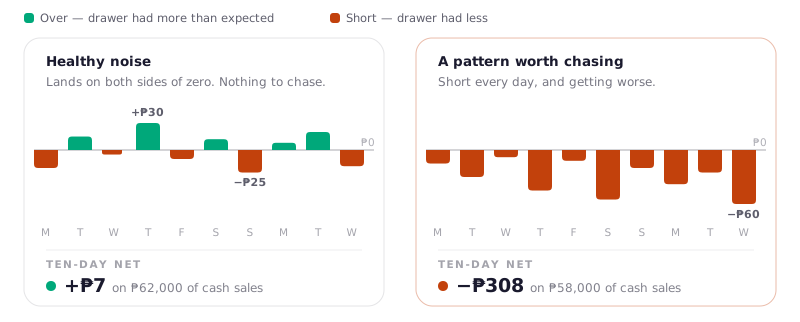
The shop on the left is fine. Days fall on both sides of zero, they cancel out, and the ten-day net is ₱7 on ₱62,000 of cash. That is a human counting money in a hurry, which is what you should expect.
The shop on the right has something going on. Not one dramatic evening — every single day short, trending worse. That is a cause, and causes can be found.
The practical rule: stop reacting to individual days. React to the direction across two weeks.
What it usually turns out to be
Ranked roughly by how often each one is the answer:
1. Change given by hand instead of using the tendered field. Someone types the total, takes ₱500, and works out the change mentally while three people wait. It is right most of the time. Most of the time is not all of the time, and the errors are small and one-directional — which is exactly what a slow daily drift looks like.
2. The float was entered wrong at open. Produces a clean, constant offset every day until someone notices. If your gap is suspiciously similar each evening, start here.
3. A payment method recorded as the wrong type. A card sale rung as cash makes the drawer short by exactly that order's value. Look for a gap that matches one order's total precisely — that specificity is the tell.
4. Orders not rung up at all. The rush hits, someone serves a regular they know, the order goes in "later" and later never arrives. This one shows as short cash and stock that has vanished without a matching sale, which is why recipe-linked inventory is a better theft detector than watching the drawer.
5. Petty cash taken from the till. Someone buys a gas refill or a bag of ice out of the drawer. Entirely legitimate, completely invisible unless it is recorded as an expense — and it will read as theft on the report if it is not.
6. Tips going in and out of the same box. If tips share the drawer with takings, the count is measuring two things at once and can never be clean. Separate container, always.
7. Actual theft. It happens, and it is last on this list for a reason. Work through the six above before you go near it.
How to tell them apart
The shape of the gap narrows it down faster than watching anyone does:
| What the gap looks like | Where to look first |
|---|---|
| Small, random, both directions | Nothing. This is normal. |
| Same amount every day | The starting float |
| Matches one order's total exactly | Payment method rung wrong |
| Short only on busy evenings | Manual change-making under pressure |
| Short with stock also unaccounted for | Orders not being rung up |
| Round numbers — ₱100, ₱500 | Petty cash, unrecorded |
| Gradual worsening over weeks | A habit forming; catch it now |
Notice that only one row of that table is about a person, and it is not the first place to look.
The habits that make this readable
Count the float at open, every time. Thirty seconds. It is the foundation everything else is measured against, and a guessed float invalidates the whole day.
Use the tendered field for every cash sale. Type what the customer handed over and let the screen do the subtraction. This single habit closes most small-drift gaps, and it is faster than mental arithmetic once it becomes automatic.
Close every shift, the same way, every day. An unclosed shift merges two days into one unreadable block. Nobody goes home until it is closed — see starting and closing a shift.
Write a note when there is a gap. "Bought ice, ₱120" takes five seconds today and is the only thing that will explain the number in March.
Record petty cash as an expense rather than as a mystery.
Read the Manager's Daily Report, not just the drawer. Over/short sits there beside voids, discounts and wastage, and the combination is far more informative than any one of them. A drawer that is short on the same evenings that voids spike is telling you something a bare cash figure never could.
When it really is a person
Sometimes it is. If you have worked the list, the pattern is confined to one person's shifts, and it survives a change in process, you have your answer.
Even then, lead with the process. "The drawer has been running short and I want to work out why" gets you further than an accusation, and it leaves you somewhere to stand if you turn out to be wrong — which, given that the top six causes on that list are all mistakes rather than malice, you often will be.
What you should not do is nothing. A gap you never mention is a gap that grows, because silence reads as permission whether you intended it that way or not.
The short version
A drawer that never balances is normal. A drawer that is consistently short is a question with a findable answer, and six of the seven likely answers are about how your shop runs rather than who works there.
Count the float. Use the tendered field. Close every shift. Write the note. Read the trend, not the day.
Kasenso does the arithmetic and keeps the history for you — the drawer count, the notes, and the voids and discounts beside them — on the free plan, permanently.