What bad weather really does to your sales
September 10, 2026 · Jott Myth · 7 min read
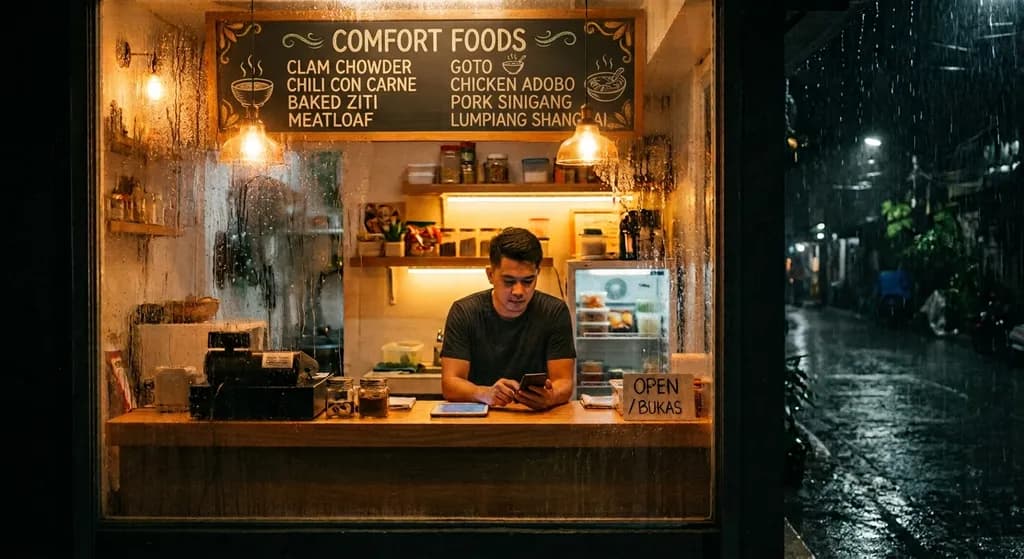
Every owner in a rainy season knows the feeling of watching the sky at four in the afternoon. The rain starts, the street empties, and the dining room stays empty for the rest of the night. You close early, you throw out prep, and you write the day off.
Here is the part that is worth knowing before you write off the next one: rain usually does not remove demand. It moves it. It moves it out of your dining room and into delivery, it moves it away from your cold drinks and toward anything hot in a bowl, and it moves the whole day's rush by an hour or two. Owners who lose money on wet days mostly lose it by preparing for the day they planned instead of the day they got.
First, find out what rain actually costs you
"Rainy days are dead" is a feeling, and it is often only half right. Before you change anything, look at what your own shop did on the last few wet days compared with the same weekday when it was dry — a rainy Tuesday against other Tuesdays, not against Saturday.
Your sales report will show you three things that matter more than the total:
- Order count. Fewer customers is a demand problem.
- Average order value. Same customers spending less is a different problem entirely, and a discount will not fix it.
- What sold. This is the one most owners skip, and it is where the useful answer usually is.
Most of the time the picture is not "everything down 40%". It is dine-in down heavily, takeout flat, soup and rice meals up, cold drinks and desserts down hard. That is not a dead day. That is a different menu selling to a smaller room.
Prep for the weather, not for the schedule
Once you know which items move when it is wet, the fix on the next rainy forecast is mostly a prep decision made at eight in the morning rather than a promo decision made at six at night.
Knowing which items, though, is the hard part — and it is the part Kasenso now does for you. Set your shop location once and it records the weather on every trading day, then tells you what actually sells in the rain: which dishes take a bigger share of a wet day, and which fall away. Not a hunch about goto, a list with numbers against it.
Prep short on the things that die in the rain — the fresh salads, the cold drinks, anything that has to look perfect on a plate for a dine-in customer who is not coming. Prep long on the hot, cheap, filling things. Goto, arroz caldo, sinigang, lugaw, mami: these sell on exactly the days everything else stops.
The cost of getting this wrong is not the lost sale. It is the spoilage, and spoilage is the quietest way a food business loses money because it never appears in your sales figures at all. If you are not already recording what you throw out, a wet week is a good week to start — three or four logged rainy days will tell you exactly how much you routinely over-prep, in pesos.
The rush moves — be there for it
Rain does not usually cancel dinner. It delays it. People wait out the worst of it, then eat late; or they skip going out entirely and order in around the same time they would have arrived.
Which means the shape of a wet day is different from the shape of a dry one, and staffing it the same way is expensive twice over: you are overstaffed through a dead five o'clock and short-handed when the late orders land together. Your peak hours on wet days are worth checking once, because they are rarely where owners assume.
If you take orders for delivery or pickup, this is the day to make sure people know you are open. A single post at the moment the rain starts — you are open, the goto is ready, here is how to order — does more than any discount you could run. KAISHA will draft it from your actual sales data if the writing is the part that stops you, and your online store gives customers somewhere to send the order that is not a Messenger thread you have to read between plates.
Do not discount a weather problem
The instinct on a slow wet night is to cut prices. It is almost always the wrong lever, for a specific reason: the customers who stayed home did not stay home because of your prices. Discounting to them is shouting through a closed window. The people who did come out in the rain are your most motivated customers of the week, and they were going to pay full price.
If you want to move something, move the item, not the price — push the hot dish, make a rice-and-soup set that is easy to order and quick to hand over. And if you do run something, set it up as a preset discount so you can tell afterwards whether it actually paid for itself. A wet-weather promo that you cannot measure is just a smaller day with extra steps.
When the power and the signal go
The other half of bad weather is the half nobody plans for. Brownouts during a storm, a signal that drops for two hours, a typhoon day where you are trading but nothing else in the neighbourhood is.
This is the moment a POS either stops being useful or quietly proves its worth. Kasenso keeps working offline — you keep taking orders, printing receipts and closing shifts with no internet at all, and everything syncs when the connection comes back. No paper fallback, no reconstructing the day's sales afterwards from memory and receipts, no gap in your reports where a storm used to be.
A tablet or phone on battery, and you are still trading when the lights go out. That is not a small thing on an island in the middle of typhoon season.
The point of tracking a bad day
It is tempting to treat a rained-out Wednesday as a day that did not count. Do the opposite. Rainy days repeat — in most of the country they repeat for months at a stretch, and on a fairly predictable pattern — which means every wet day on record makes the next twenty easier to prep for, staff for and price.
The good news is that this is no longer a chore anyone has to remember. Kasenso records the weather against each trading day on its own, overnight, with nothing to tick off at closing. And because it can look up the weather for days you have already traded, a shop that has been open since May gets a full season of rainy days the moment it switches this on — the answer is there today, not next season.
The owners who handle the rainy season well are not the ones with a clever promo. They are the ones who know, from their own numbers, that goto triples and iced drinks halve when it pours — and who prep accordingly before the first drop lands.
Kasenso records every sale as it happens, tags each day with the weather it happened in, and sends you a summary at the end of every trading day, rain or shine. It is free for restaurants, cafés and food stalls — the free plan is a real plan, not a trial that flips to a subscription.
And if your quiet stretch turns out to have nothing to do with the weather, what to do when sales are slow works through the other causes.