What to do when sales are slow
August 29, 2026 · Jott Myth · 9 min read
A quiet week is uncomfortable in a specific way. You are still paying rent, the staff are still on the clock, and the stock in the chiller is quietly getting older. The pressure to do something builds fast, and the something almost everyone reaches for first is a discount.
Hold that thought for a few days. A discount is the most expensive lever you own and the one most likely to be pulled at the wrong problem. Before you touch it, it is worth spending twenty minutes finding out what is actually slow.
Is it slow, or does it only feel slow?
Two bad Tuesdays feel like a collapse when you are standing behind the counter with nothing to do. Compare like with like before you conclude anything:
- Same weekday, not yesterday. A Tuesday is supposed to be worse than a Saturday. Comparing them tells you only that the calendar works.
- The pay cycle. Sales around the 15th and the 30th are not the same business as sales on the 8th. A "slump" that ends every payday is a cash-flow pattern in your customers, not a problem in your shop.
- Last year, if you have it. School terms, fiesta weeks, rainy afternoons and the long stretch after Christmas are all real and all repeat.
Your revenue trend over twelve months answers this faster than memory does, and memory is unreliable here — a bad week you lived through feels much larger than a bad week in a chart.
If the same weekday last month and the same week last year both look like this, you are not in a slump. You are in your normal low season, and the right move is to spend it on the work further down this page rather than on a panic promo.
One number tells you which problem you have
If it really is down, split the revenue before doing anything else. Every peso of sales is exactly two things multiplied together:
Revenue = number of customers × average order value
A 22% drop can come entirely from either side, and the two look identical on the sales total while needing opposite responses.
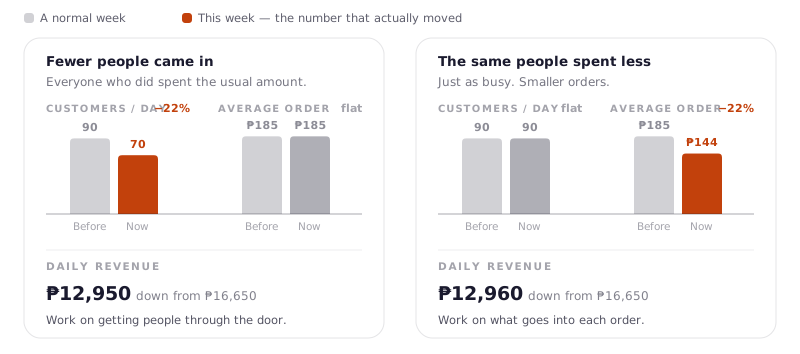
The shop on the left has a traffic problem — fewer people are walking in, and the ones who do behave exactly as they always did. The shop on the right has a basket problem — it is as busy as ever, but the orders are smaller.
Advertising the right-hand shop harder just brings in more people to place the same shrunken orders. Reworking the right-hand shop's menu does nothing for the left-hand one, where the menu was never the issue. Same symptom, different disease, and you cannot tell them apart from the revenue line alone.
Your sales reports carry both numbers — order count and average order value — beside the total. Look at the pair, not the sum.
If it is a traffic problem
Fewer people are coming. Some of this you control and some of it you do not, so start with what you do.
Check that your hours match your customers' hours. The peak-hours breakdown shows when money actually arrives. Shops routinely open an hour before anyone wants them and close half an hour before the last wave would have come. Both cost real money, and neither shows up as a problem anywhere.
Be findable. A Google Business Profile with correct hours, a current photo and a number that gets answered is free, and it does more for a small food business than most paid posts. If your hours online are wrong, you are losing customers you will never hear about.
Give the people who already like you a reason to come back this week. Your customer records show who used to buy regularly and has not lately. That list is worth far more than an equivalent number of strangers, and it costs almost nothing to reach.
Post something, consistently, even when nothing is new. Small shops go quiet online in exactly the weeks they are quiet in real life, which is backwards. KAISHA can draft posts from your actual sales data if the blank page is the thing that stops you.
Take the order where the customer already is. If people are ordering delivery from shops like yours, an online store link you can paste into a chat catches demand that was never going to walk in.
If it is a basket problem
Just as many customers, smaller orders. This one is more within your control than traffic, and usually cheaper to fix.
Find out what stopped selling. In the product-level report, a falling average order almost always traces to one or two lines — a drink that stopped being offered, an add-on that quietly vanished from the menu board, a combo somebody stopped mentioning.
Check that your choices and add-ons are still being offered out loud. An upsize nobody suggests is worth zero. This is the most common cause of a shrinking basket in a shop that is otherwise running normally, and fixing it costs nothing — it is a conversation at the start of a shift, not a change to the business.
Look at your discounts before adding more of them. If the average order fell while the customer count held, check whether discounts rose over the same period. Sometimes the basket did not shrink at all; you just started giving more of it away.
Bundle rather than cut. Two items at a small saving protects your margin far better than one item at a large one, because the customer still leaves with two things.
The arithmetic that should scare you off a blanket discount
Here is why "20% off everything" is not the safe, obvious move it feels like.
Take a ₱200 dish that costs you ₱80 in ingredients. You make ₱120 on it. Discount it 20% and you sell at ₱160, still spending ₱80 — so you now make ₱80. To finish the day with the profit you had before, you need to sell 50% more of them.
| Discount | At 60% gross margin | At 50% gross margin |
|---|---|---|
| 10% off | need +20% volume | need +25% volume |
| 20% off | need +50% volume | need +67% volume |
| 30% off | need +100% volume | need +150% volume |
Read the bottom row again. A 30% discount on a 50%-margin dish needs two and a half times the volume just to stand still — and you are working much harder for it, burning more stock and more staff hours on the way.
Discounts are not forbidden. They are a tool for a specific job: moving stock that would otherwise spoil, filling a genuinely dead hour with people who were never going to pay full price anyway, or buying a first visit from someone you expect to see again. What they are not is a response to a slow week.
If you want to know what a price change would actually do before you commit, Price Lab runs it against your own sales history rather than against a feeling.
Use the slow hours instead of enduring them
A quiet stretch is the only time you will ever have for the work that makes busy weeks profitable. It is worth something.
Count your stock properly. A slow week is the only week a real inventory count is possible without wrecking service.
Deal with what is about to spoil. Wastage quietly spikes in slow weeks, because you ordered for a normal one. Cut the next order before the chiller decides for you.
Trim the variable costs it is safe to trim. Under-ordering perishables for a week you already know will be quiet is a decision, not a panic. So is dropping one shift on the day your peak-hours chart says is dead.
Go through your expenses. Subscriptions, a delivery you no longer need, a supplier whose prices crept up last quarter. A ₱2,000 recurring cost you cancel this week beats a promo that might work.
Fix the thing you always mean to fix. The menu photo that looks bad. The recipe whose yields have never been right. The cashier nobody has shown how to use the tendered field — see why your cash drawer never balances. None of it happens in a busy month.
What not to do
Do not cut quality. Smaller portions and cheaper ingredients are the fastest way to turn a slow month into a slow year. Regulars notice immediately, and they do not complain — they just stop coming.
Do not let go of people over a bad fortnight. Rehiring and retraining costs more than the shifts you saved, and the busy week that follows will find you short.
Do not change five things at once. Change one, give it two weeks, and look for it in the numbers. Five simultaneous changes teach you nothing, because you will never know which one worked.
Do not stop opening the reports because they are depressing. The weeks you most want to avoid the numbers are the weeks the numbers have the most to say.
The short version
A slow week is a question, not a verdict. Check that it is real by comparing the same weekday and the same season. Split the drop into customers and average order, because the two fixes point in opposite directions. Treat discounting as a tool with a specific job rather than a reflex — the volume it demands back is larger than it looks. And spend the quiet hours counting, cutting and fixing, which is the only thing that makes the next busy week worth more than the last one.
Kasenso keeps the customer count, the average order, the discounts and the trend in one place, so a slow week is something you can read instead of something you have to guess at — on the free plan, permanently.