7 small business ideas you can start with ₱50,000 in the Philippines
November 8, 2026 · Kasenso · 14 min read
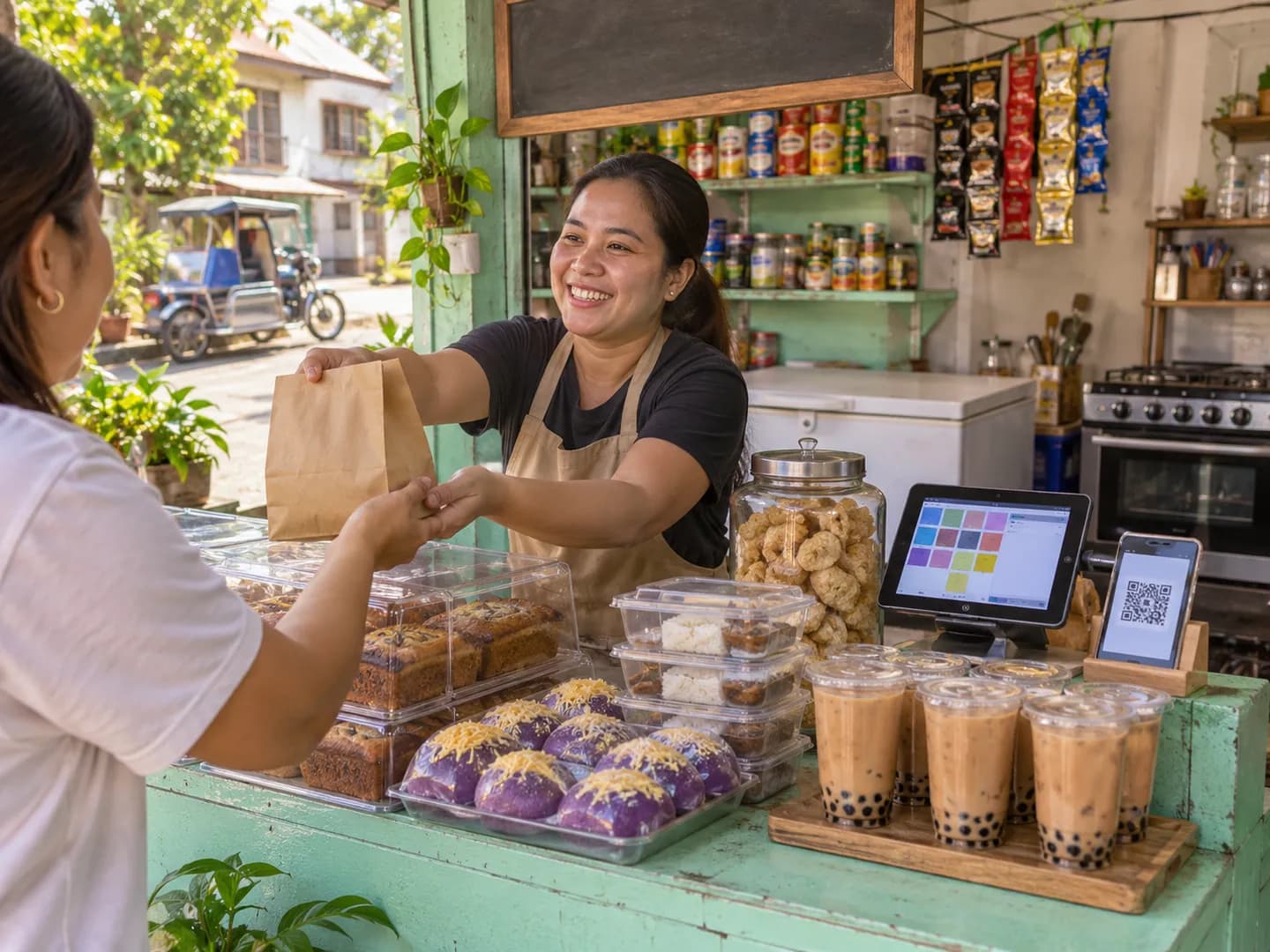
In short: ₱50,000 is enough to start a small food, retail or service business from home or a cart in the Philippines, as long as you skip rent and staff at first. Spend about ₱40,000 opening, keep ₱10,000 untouched, and pick something people buy every day or every week.
What small business can I start with ₱50,000 in the Philippines?
Home baking, packed lunches to order, an own-brand coffee or milk tea kiosk, a sari-sari store, a street food cart, frozen food reselling and a home nail service all open for ₱17,500 to ₱40,000. Each runs without rent or wages at the start, so it can cover its costs at a handful of sales a day and still leave ₱10,000 in reserve.
How do the ₱50,000 business ideas compare?
The seven below, side by side. Setup costs are rough late-2026 prices for a city or town outside central Metro Manila; check them against your own suppliers before you buy anything.
| Business | Setup cost | You keep per sale | Sales a month to cover costs |
|---|---|---|---|
| Home baking (banana bread, pandesal, cakes) | ₱26,000 | ₱115 a loaf | 18 loaves |
| Packed lunches to order | ₱17,500 | ₱45 a meal | 98 meals |
| Own-brand coffee or milk tea kiosk | ₱40,000 | ₱49 a cup | 102 cups |
| Sari-sari store from your home | ₱37,000 | 15% of each sale | ₱7,340 of sales |
| Street food cart | ₱26,500 | ₱15 a cup | 260 cups |
| Frozen food reselling | ₱34,500 | ₱40 a pack | 30 packs |
| Home nail service | ₱20,500 | ₱240 a client | 5 clients |
"Sales to cover costs" is your break-even: the point where what you keep from each sale pays the monthly bills you have even on a day you sell nothing. Everything above it is profit, before you pay yourself.
How should you split ₱50,000 when starting a business?
In three parts, and the last one is the one people skip:
| Part | Share | On ₱50,000 |
|---|---|---|
| Equipment, first stock, signage | about 70% | ₱35,000 |
| Permits and registration | about 10% | ₱5,000 |
| Reserve you do not touch | about 20% | ₱10,000 |
The reserve pays for the quiet second month, the LPG tank that runs out early and the batch that does not sell. A business that opens with its last peso in stock has nothing to fall back on. For the full version of this sum, with rent and wages, see how to start a small shop.
1. Home baking: banana bread, pandesal and cakes
Baking from your own kitchen is the cheapest way into food: no rent, and you bake to order, so little goes to waste.
| Cost | Amount |
|---|---|
| Oven (a 45-litre electric oven or a gas range with oven) | ₱8,000 |
| Stand or hand mixer | ₱3,500 |
| Loaf pans, trays, bowls, scale | ₱3,000 |
| Boxes, bags and labels for the first batches | ₱2,500 |
| First flour, sugar, eggs, butter, bananas | ₱6,000 |
| Registration and permits | ₱3,000 |
| Total | ₱26,000 |
The arithmetic: a banana bread loaf sells for ₱200 and costs ₱85 in ingredients and box, so you keep ₱115. Extra LPG or electricity and mobile data add about ₱2,000 a month, so 18 loaves cover it. At 5 loaves a day for 26 days, that's 130 loaves × ₱115 = ₱14,950, minus ₱2,000 = ₱12,950 a month, and the setup is paid back in about two months.
Cost your recipe before you set the price. Butter and eggs move, and a loaf priced on last year's costs can quietly sell at a loss — see how to price your menu.
2. Packed lunches to order
Office workers, construction crews and students near a school buy lunch every working day. Take orders the evening before, cook once in the morning, and deliver by 11.
| Cost | Amount |
|---|---|
| Large pots, rice cooker, extra burner | ₱5,000 |
| Insulated delivery bags | ₱1,500 |
| First 500 meal containers and spoons | ₱2,500 |
| First week of ingredients | ₱5,000 |
| Registration, sanitary permit, health certificate | ₱3,500 |
| Total | ₱17,500 |
The arithmetic: a rice-and-ulam meal at ₱100 costs ₱55 with the container, so you keep ₱45. Two LPG tanks, data and fuel for deliveries come to about ₱4,400 a month, so 98 meals cover it, about 5 a working day. At 30 meals a day for 22 working days, that's 660 × ₱45 = ₱29,700, minus ₱4,400 = ₱25,300 a month.
Pre-orders are what make this work: you cook for orders, not for hope. Ask for payment by GCash or Maya when the order is placed, so nobody cancels after you have already cooked.
3. An own-brand coffee or milk tea kiosk
A kiosk near a school, terminal or office building sells cold drinks all day. Building your own brand instead of buying a franchise package keeps it inside ₱50,000.
| Cost | Amount |
|---|---|
| Kiosk cart, made by a local fabricator | ₱15,000 |
| Cup sealer, shakers, blender | ₱8,000 |
| Ice chest | ₱2,500 |
| First powders, pearls, cups, straws | ₱6,000 |
| Signage and menu board | ₱2,000 |
| Registration and permits | ₱3,500 |
| First month's rent for the spot | ₱3,000 |
| Total | ₱40,000 |
The arithmetic: a ₱79 cup costs about ₱30 to make, so you keep ₱49. Spot rent, ice, electricity and data come to about ₱5,000 a month: 102 cups, or 4 a day. Hire a helper at ₱400 a day for 26 days and monthly costs become ₱15,400, which needs 315 cups, or about 12 a day. That is why it pays to run the kiosk yourself until you sell well past that.
4. A sari-sari store from your home
A neighbourhood store sells what people run out of: drinks, snacks, canned goods, coffee sachets, soap, load. It needs no new skill, only a front window and steady stock.
| Cost | Amount |
|---|---|
| Shelving and a counter | ₱5,000 |
| Window screen or grill | ₱4,000 |
| First stock | ₱25,000 |
| Registration and permits | ₱2,500 |
| Signage | ₱500 |
| Total | ₱37,000 |
The arithmetic: goods typically cost about 85% of their shelf price, so you keep 15% of each sale. Extra electricity and data add about ₱1,100 a month, so ₱7,340 of sales covers it, about ₱245 a day. At ₱3,000 of sales a day, you keep ₱450 a day, or ₱13,500 over 30 days, minus ₱1,100 = ₱12,400 a month.
A sari-sari store lives on volume, and on goods coming back in: every peso on a neighbour's tab is a peso you cannot restock with. Write down who owes what, and set a limit before someone's tab reaches ₱2,000. A customer account keeps that tab for you.
5. A street food cart: fishballs, kikiam and kwek-kwek
Fried street food sells near schools, terminals and basketball courts in the afternoon and early evening, and the ingredients are cheap.
| Cost | Amount |
|---|---|
| Cart with a frying station | ₱12,000 |
| Wok, burner and LPG tank | ₱5,000 |
| First fishballs, kikiam, quail eggs, sauces | ₱4,000 |
| Sticks, cups and napkins | ₱1,000 |
| Umbrella and signage | ₱1,500 |
| Registration and permits | ₱3,000 |
| Total | ₱26,500 |
The arithmetic: a ₱25 cup costs about ₱10, so you keep ₱15. LPG and a small spot fee come to about ₱3,900 a month: 260 cups, or 10 a day. At 60 cups a day for 26 days, that's 1,560 × ₱15 = ₱23,400, minus ₱3,900 = ₱19,500 a month.
Weather moves this business more than any other on the list: a rainy week can halve it. Watch which days and hours actually sell, and see selling in bad weather for what to do when it pours.
6. Frozen food reselling: tocino, longganisa, siomai
Buy frozen goods wholesale from a supplier or a home producer, store them in a chest freezer, and sell to neighbours and by delivery. There is no cooking, and stock keeps for weeks.
| Cost | Amount |
|---|---|
| Chest freezer, 7 cubic feet | ₱15,000 |
| First stock | ₱15,000 |
| Cooler bag and ice packs for delivery | ₱2,000 |
| Registration and permits | ₱2,500 |
| Total | ₱34,500 |
The arithmetic: a pack you buy at ₱120 and sell at ₱160 leaves ₱40. The freezer's electricity and data add about ₱1,200 a month: 30 packs. At 15 packs a day for 30 days, that's 450 × ₱40 = ₱18,000, minus ₱1,200 = ₱16,800 a month.
Check each product's best-before date when it arrives and sell the oldest first. A freezer full of expired tocino is the one way this business loses money fast. If the power cuts out for long, keep the lid shut: a full chest freezer stays frozen far longer than one you keep opening.
7. A home nail service
Gel manicures and pedicures at clients' homes, or in a corner of your own, pay well per hour and need no stock beyond supplies.
| Cost | Amount |
|---|---|
| Gel polish set, UV/LED lamp, tools, sterilizer | ₱12,000 |
| Folding table and chair | ₱3,000 |
| First supplies: files, cotton, remover, sanitizer | ₱3,000 |
| Registration and permits | ₱2,500 |
| Total | ₱20,500 |
The arithmetic: a ₱350 gel manicure uses about ₱60 of supplies, and a home visit costs about ₱50 to reach, so you keep ₱240. Data and sanitizer come to about ₱1,000 a month: 5 clients. At 3 clients a day for 26 days, that's 78 × ₱240 = ₱18,720, minus ₱1,000 = ₱17,720 a month.
Fill the calendar ahead instead of waiting for messages. Clients who book a time turn up more often than clients who say "maybe Saturday", and a reminder the day before helps more — see take bookings.
Is a ₱50,000 food cart franchise worth it?
Sometimes. A franchise package hands you a cart, a recipe, a brand people know and a supplier, which saves you the trial and error. But at ₱50,000 the package usually takes the whole budget, leaving no reserve, and you keep buying supplies from the franchisor at their price. Before you sign, ask:
- What does a cup or piece cost you from their supplies, and what does it sell for? Work out what you keep per sale, as above.
- Are there monthly fees or a share of sales on top of the package?
- Can you move the cart if the first spot does not sell?
- How many other branches are within walking distance of your spot?
If what you keep per sale is no better than an own brand would give you, the brand name is the only thing you are paying for.
What permits do you need to start a small business in the Philippines?
Register in this order, and budget ₱2,500 to ₱5,000 for all of it, depending on your city:
- DTI business name registration, online. The fee depends on how far your name reaches: ₱200 for one barangay, ₱500 for a city or municipality, ₱1,000 for a region, ₱2,000 nationwide, plus ₱30 documentary stamp tax.
- Barangay clearance from the barangay hall where you operate.
- Mayor's or business permit from city or municipal hall. This is usually the largest fee.
- Sanitary permit and health certificates if you make or sell food. Each person handling food needs a health certificate.
- BIR registration at the Revenue District Office (RDO) for your address, with official receipts or invoices.
You can also register as a Barangay Micro Business Enterprise (BMBE) at your city's Negosyo Center if your business assets stay under ₱3 million. It exempts the business from income tax. On BIR, most small sellers with gross sales under ₱3 million a year can choose a flat 8% tax on sales above the first ₱250,000. Rules change, so confirm both with your RDO and Negosyo Center before you file.
How do you get your first customers?
Start with the people who already know you, then reach the ones who don't:
- Tell your street and your family group chats on day one, with a photo and a price.
- Post on a Facebook page every few days: the product, the price, how to order. See the Facebook post you keep meaning to write.
- Give people a link to order from, so orders don't get lost in Messenger. A free Kasenso online store gives each order a code, takes GCash, Maya or bank transfer before you cook, and can list your shop on Kasenso Marketplace, where people search for food, shops and services in their town.
- Keep the ones who come back. A regular buying lunch every working day is worth more than any one-time rush.
Which businesses won't fit a ₱50,000 budget?
Some popular ideas cost far more than they look:
| Business | Why it doesn't fit |
|---|---|
| Water refilling station | Purification equipment alone usually runs well over ₱200,000 |
| Laundry shop | Commercial washers and dryers, plus a space with water and drainage |
| Mall kiosk | Monthly rent and a security deposit can pass ₱50,000 before you sell |
| Small restaurant with seating | Rent, fit-out and staff wages from the first month |
Each can come later. Many start as one of the seven above, run from home or a cart until it proves itself. If you have closer to ₱100,000, see 7 small business ideas you can start with ₱100,000.
Frequently asked questions
What is the best business to start with ₱50,000 in the Philippines?
The best one is the business people near you already buy every day. Packed lunches and home baking cost the least to start and need few sales to break even. A sari-sari store and a street food cart sell daily without special skills. Pick the one that matches your street, your hours and what you can make well.
Can I start a business with ₱50,000 and no experience?
Yes, if you choose one that needs no special skill: a sari-sari store, frozen food reselling or a street food cart. Start small, keep ₱10,000 in reserve, and write down every sale and every expense from day one, so you know within a month whether it is working.
How much profit can a ₱50,000 business make a month?
In the examples above, roughly ₱12,000 to ₱25,000 a month before you pay yourself, once sales reach a steady level. That depends on selling well above break-even: a street food cart selling 60 cups a day keeps ₱19,500, but one selling 10 cups a day only covers its LPG and spot fee.
How long does it take to earn back ₱50,000?
One to three months for most of the seven businesses, if sales reach the levels shown. Home baking at 5 loaves a day earns back its ₱26,000 setup in about two months. Expect the first month to be slower than the rest, which is what the ₱10,000 reserve is for.
How much does it cost to register a small business in the Philippines?
About ₱2,500 to ₱5,000 in total for most small businesses. DTI registration costs ₱200 to ₱2,000 depending on scope, plus barangay clearance, a mayor's permit and BIR registration. Food businesses also need a sanitary permit and health certificates. The mayor's permit varies most from city to city.
Should I buy a franchise or start my own brand with ₱50,000?
An own brand usually leaves more of the ₱50,000 for a reserve and lets you buy supplies at the best price you can find. A franchise gives you a known brand and a tested recipe, but the package often uses the whole budget and ties you to its supplies. Compare what you keep per sale before you choose.
Can I run a ₱50,000 business from home?
Yes. Home baking, packed lunches, frozen food reselling, a sari-sari store and a home nail service all run from home, which is why they fit the budget: no rent. You still need a barangay clearance and a business permit, and a food business needs a sanitary permit even when you cook in your own kitchen.
How do I keep track of sales and stock in a small business?
Write down every sale and every purchase from the first day, in a notebook or on a till app. Kasenso is a free point-of-sale app for phones, tablets and browsers that records each sale, takes stock off as you sell, and shows what you made each day. See getting started.