How to manage part-time staff in a small shop
November 13, 2026 · Jott Myth · 9 min read
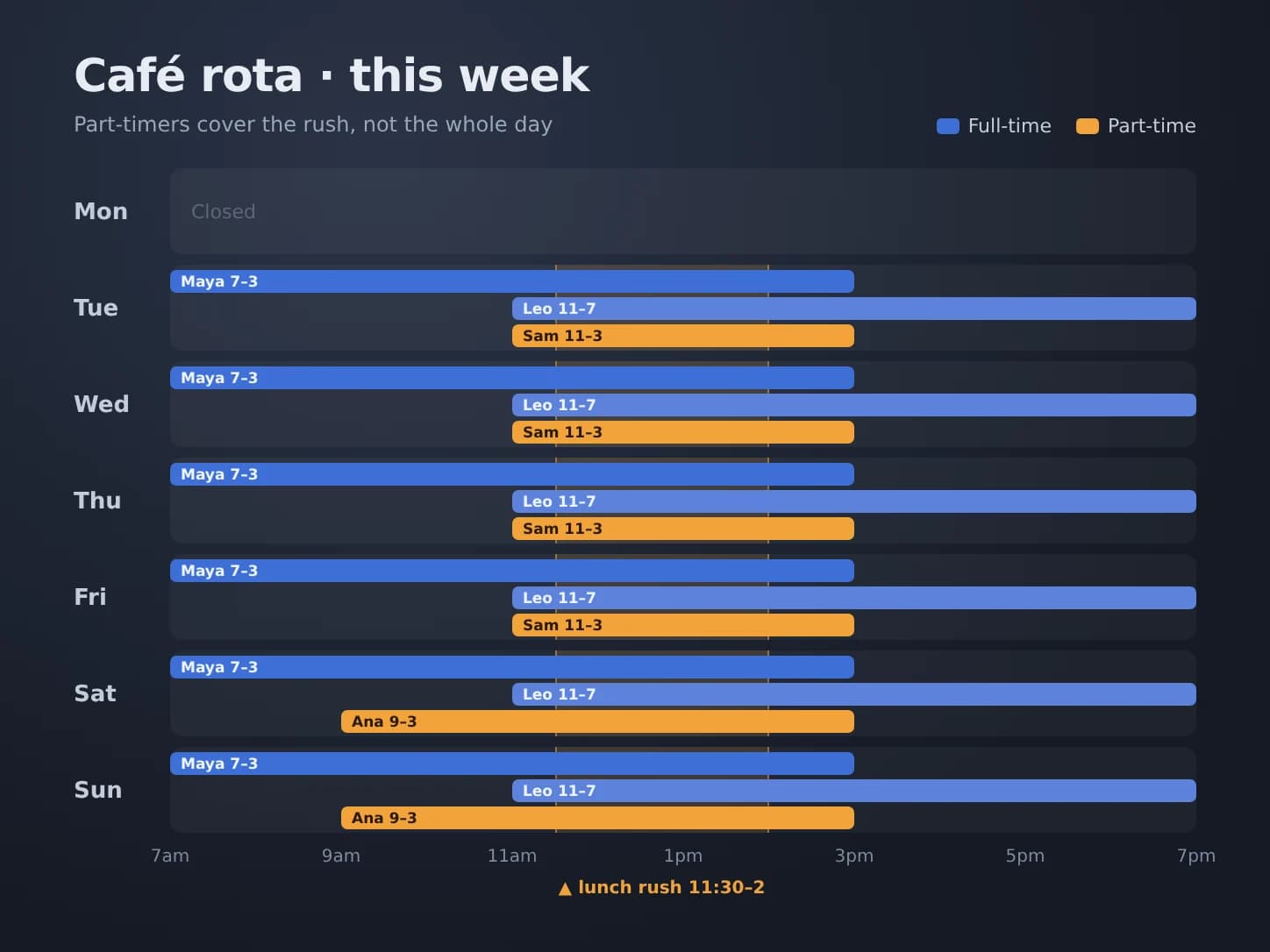
Most small shops are not busy all day. They are busy for two hours at lunch, one hour after work, and most of Saturday. Hiring a second full-time person to cover those hours means paying for the quiet ones as well. A part-timer is how you pay for the rush and only the rush.
How do you manage part-time staff in a small shop?
Schedule part-timers for your busiest hours, not for whole days. Give each one their own login with only the screens they need, have them count the cash drawer at the start and end of every shift, and hand over by closing one shift before the next person opens theirs. That keeps every sale and every drawer count attached to one person.
When does a part-time employee make sense?
When the extra work comes in a block that is shorter than a full shift. Look at your sales by hour for a normal week. If one or two stretches carry most of the orders and the rest of the day is steady, you need more hands at those times, not more hours across the whole day.
Here is the arithmetic for a café open six days a week with a lunch rush from 11:30 to 2:00, at an example wage of $12 an hour:
| Second full-timer | Part-timer, 11:00 to 3:00 | |
|---|---|---|
| Hours a day | 8 | 4 |
| Days a week | 6 | 6 |
| Weekly wages | 8 × 6 × $12 = $576 | 4 × 6 × $12 = $288 |
Both cover the rush. The part-timer costs $288 a week less, because you are not paying anyone to wipe tables at 4pm.
Then work out what the extra person has to earn back. If your food sells at a 65% gross margin, the part-timer pays for themselves at:
$288 ÷ 0.65 = $443 of extra sales a week, or about $74 a day
At an $8 average order, that is roughly nine more lunch orders a day. A line that no longer walks away usually adds that much on its own. If it doesn't, the rush was not the problem. Add whatever your country requires employers to pay on top of wages before you trust the numbers.
How many hours should a part-timer work?
Long enough to cover the peak with a little either side, and no longer. The 30 minutes before a rush go on setting up and the 30 minutes after it go on catching up, so a two-and-a-half-hour lunch rush is usually a four-hour shift.
A few rules make the schedule easier to keep:
- Fix the shifts. "Tuesday to Saturday, 11 to 3" is easier to staff and to keep than hours that change every week.
- Keep a weekend group. Students and people with weekday jobs often want only Saturday and Sunday, which is exactly when many shops need them.
- Have one backup name per shift. Part-timers have other commitments, and the shift that falls through is always the busy one.
- Check your local rules. Many countries have rules on minimum shift length, breaks, notice of the schedule and how many hours count as part-time. They differ widely, so check before you set the rota.
In Kasenso, plan the week under Schedule. Tick Tuesday to Friday once and a part-timer's four lunch shifts are added together, and Copy last week carries a settled rota forward. Each day is drawn against your busy hours from the last four weeks of sales, so a rush with one person on it stands out. Your part-timers open the app and see their own shifts at the top. The schedule guide shows each step.
Should each part-timer have their own POS login?
Yes, every time. A shared "counter" login is the most common reason a small shop can't tell who sold what, who gave a discount or whose drawer came up short. Once two people use the same login, the history can't be separated afterwards.
In Kasenso, add each part-timer under Staff with their own username and password, and tick only the screens they need. A sensible part-timer set is Point of Sale and Total Sales. Leave Void Orders & Refunds off, so a sale can only be cancelled by someone you trust with it. If you hire part-timers often, save that set once as a role called Part-time and pick it for each new person. The staff accounts guide walks through it.
How do part-timers handle the cash drawer?
Each person counts the drawer when they start and when they finish. A staff account in Kasenso can't take an order until a shift has been started with a counted float, and closing the shift compares the cash counted with what should be there:
Expected in drawer = starting float + cash sales − cash paid out
Over or short = cash counted − expected
The hard part with part-timers is the handover. If the lunch part-timer leaves at 3 and the afternoon person carries on in the same shift, any gap belongs to both of them and to neither. So at 3pm, the part-timer closes their shift and counts the drawer, and the next person starts a new shift with that count as their float. It takes two minutes and gives each person a drawer of their own. See start and close a shift for each step.
How do you train a part-timer quickly?
Part-timers get fewer hours to learn the job, so their first shift should cover only what they need on their own:
- Taking an order at the cash register, including your most common add-ons.
- Taking cash with the tendered field. Type what the customer handed over and let the screen work out the change. It is faster than mental arithmetic and closes most small drawer gaps.
- What to do with a mistake. Who to call for a void or refund, since they can't do one themselves.
- Closing their shift and counting the drawer at handover.
- Where things are: spare receipt rolls, bags, the number to call in a power cut.
Put the first shift alongside someone experienced, and on a quieter day than the one they will normally work.
How do you pay part-time staff fairly?
Most part-timers are paid by the hour, at the same hourly rate as full-time staff in the same job. In Kasenso, set each person's hourly rate on Payroll and it works out their pay from the hours they clocked, twice a month, with overtime if you use it (guide). It doesn't calculate tax or deductions. Schedule also totals each person's planned hours for the week, and beside each past shift it shows when that person actually opened and closed the cash register. That is the starting point for checking hours before you pay.
What Kasenso can add is each person's sales. Every order is tagged with the cashier who took it, so reports and the Manager's Daily Report show what each part-timer sold. If you pay a share of sales, as many salons and barbers do, team and commission works out what each person is owed, and it can share out tips taken at checkout too.
What do you do when a part-timer leaves?
Deactivate their account rather than deleting it. Setting Account Status to Inactive stops their password working on every device at once, and keeps every sale, shift and drawer count they were part of. Deleting can't be undone.
That matters even more for seasonal staff. Someone who works every summer can be switched back to Active next year with their login and history intact, so you don't set them up again from nothing.
Frequently asked questions
What is a part-time employee?
A part-time employee works fewer hours than a full-time one, usually on a fixed pattern of shorter shifts or fewer days. How many hours counts as part-time differs by country, and in many places it affects pay, breaks and benefits, so check the definition that applies where your shop is.
Why hire part-time staff instead of another full-timer?
Because most small shops are busy in blocks, not all day. A part-timer covers the lunch rush or the weekend without you paying for the quiet hours. In the example above, covering a lunch rush part-time costs $288 a week against $576 for a second full-timer.
How much does a part-time employee cost?
Their hours times their hourly rate, plus any employer costs your country adds. Four hours a day, six days a week at $12 an hour is $288 a week in wages. At a 65% gross margin, they need to bring in about $443 of extra sales a week to pay for themselves.
How do I schedule part-time staff around a rush?
Find your busiest hours from your sales by hour, then set a fixed shift that starts about 30 minutes before the rush and ends about 30 minutes after it. A two-and-a-half-hour lunch rush usually becomes a four-hour shift. Kasenso's Schedule shades each day's busy hours from your sales, so you can see it.
Should part-time staff share a POS login?
No. A shared login makes it impossible to tell who sold what, who gave a discount or whose drawer was short, and that can't be fixed afterwards. Give every part-timer their own login, with only the screens they need, such as Point of Sale and Total Sales.
How do I hand over the cash drawer between shifts?
The person leaving closes their shift and counts the drawer. The person arriving starts a new shift with that counted amount as their starting float. Each person then has a drawer of their own, and any gap belongs to one shift instead of being shared.
When should I deactivate a part-timer's account?
On their last day. Deactivating stops their login working everywhere at once and keeps their sales and shift history, which you may need later. A seasonal worker can be switched back to active next season with their account as it was.