How to sell other people's goods on consignment without losing track of what you owe
November 9, 2026 · Jott Myth · 10 min read
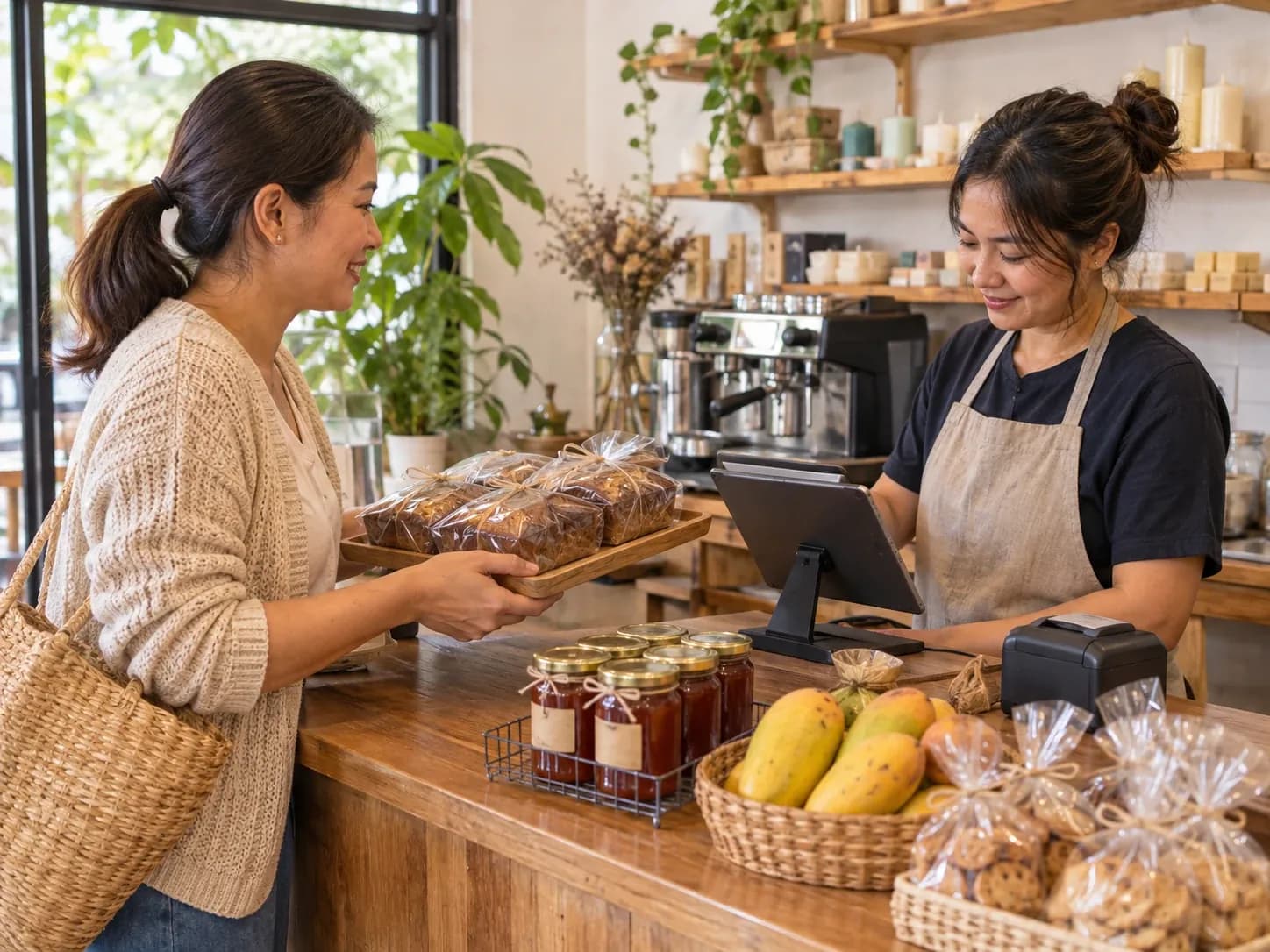
A neighbour bakes banana bread and asks if you would sell it at your counter. You say yes, she drops off twelve loaves on Monday, and on Friday she comes back asking how many sold. You think it was nine. Or was it ten, and one went to a staff member? And did you agree on $1 a loaf for you, or 25%?
That conversation is where most consignment arrangements go wrong. Not because anybody cheats, but because nobody wrote anything down. Here is how to set the terms, work out the money, and keep a count that both of you trust.
What is selling on consignment?
Selling on consignment means you put someone else's goods on your shelf and pay them only for what sells, keeping a commission. You don't buy the stock first, so there is no money tied up and nothing lost if it doesn't sell. Unsold goods go back to their owner. Cafés, fruit stalls, farm shops and gift shops sell this way.
Why sell on consignment at all?
Because it adds products to your shelf for no money down. A café that buys twelve loaves of banana bread at $3 each has $36 at risk before the first slice sells. On consignment it has nothing at risk, and it earns on every loaf that does sell.
It suits:
- Goods you are not sure will sell. Try a new maker's candles for a month before committing money to them.
- Seasonal or fresh goods. A grower's mangoes in season, a baker's holiday cakes.
- Local makers your customers like to support. Honey, jam, crafts, art, hand-made soap.
- A shop short on cash. Consignment fills a shelf without touching the money you need for rent and your own stock.
The trade-off is that you keep less per item than you would on goods you bought outright, and you take on the job of counting someone else's money.
What commission should I charge on consignment?
Between 20% and 40% of the selling price is the usual range for small shops. Food and fresh produce sit at the lower end, around 15–25%, because it moves fast and spoils if it doesn't. Crafts, art and clothing sit higher, 30–40%, because they take shelf space for weeks.
Push towards the higher end when:
- the item takes up a lot of shelf or fridge space,
- it sells slowly,
- your staff have to explain it, wrap it or handle it carefully, or
- you are giving the maker a place in a busy shop they couldn't reach alone.
Go lower for goods that bring customers in, like fresh bread every morning that people come back for and buy coffee with.
Percentage or a fixed amount per item?
There are two ways to agree on the split, and the right one depends on who sets the price.
A percentage means you keep a share of whatever the item sells for. At a 20% commission on a $2.00 mango, you keep $0.40 and the grower gets $1.60. If you raise the price, both of you earn more.
A fixed amount means the owner gets a set sum for every one sold, whatever you sell it for. The grower gets $1.60 a mango, and you keep everything above it. This is how a lot of produce and bakery arrangements actually work: the baker says "I want $3 a loaf", and the shop decides its own price.
| Percentage (20%) | Fixed amount ($1.60) | |
|---|---|---|
| Mango sold at $2.00 | You keep $0.40, owner $1.60 | You keep $0.40, owner $1.60 |
| Mango sold at $2.50 | You keep $0.50, owner $2.00 | You keep $0.90, owner $1.60 |
| Mango sold at $1.50 | You keep $0.30, owner $1.20 | You lose $0.10, owner $1.60 |
The two agree at $2.00 and drift apart from there. A fixed amount gives you more when you raise the price and costs you when you cut it, so never sell a fixed-amount item below what you owe on it.
Who pays for a discount?
Agree this before the first sale, because it is the question that sours the relationship later. The cleanest rule: the shop pays for its own discounts. The owner is paid on the full price, and the discount comes out of your share.
Take 10% off a $2.00 mango on a 20% commission. The customer pays $1.80, the grower is still owed $1.60, and you keep $0.20 instead of $0.40. You chose to give the discount, and the grower's "$1.60 a mango" stays true.
How do I work out what I owe a consignor?
Count what sold, then apply the terms.
- Count what sold. Items delivered, minus items still on the shelf, minus anything handed back. Not what you remember selling.
- Subtract returns. A customer who brought a jar back means one fewer sold.
- Apply the terms. On a percentage, multiply the sales by the owner's share. On a fixed amount, multiply the number sold by their amount.
- Subtract what you have already paid. If you paid half last week, what you owe now is the rest.
Here is one week at a café selling a baker's goods on fixed amounts:
| Item | Sold | Price | Sales | Baker gets | Owed | You keep |
|---|---|---|---|---|---|---|
| Banana bread | 10 | $4.50 | $45.00 | $3.00 each | $30.00 | $15.00 |
| Cookies, bag of 6 | 18 | $3.00 | $54.00 | $2.00 each | $36.00 | $18.00 |
| Total | 28 | $99.00 | $66.00 | $33.00 |
The café owes $66.00 for the week and earned $33.00, a third of the sales, with nothing paid up front.
Is the money from consignment sales my profit?
No, and this is the mistake that makes a shop look more profitable than it is. Of the $99.00 above, only $33.00 is yours. The other $66.00 is the baker's money sitting in your drawer.
If your books count the full $99.00 as revenue and you then record paying the baker as an expense, the totals work out, but every day in between your profit looks $66.00 too high. Treat the owner's share as the cost of each consigned sale the moment it sells, and your profit shows only what you kept. Then the payment to the baker isn't an expense at all; it is handing over money that was never yours.
How often should I pay consignors?
Weekly, every two weeks or monthly are all common. Fresh goods are usually paid weekly, because the maker needs the money to buy ingredients for the next batch. Crafts and art are more often monthly.
Whatever you choose, pick a fixed day and stick to it. A maker who is paid every Friday trusts the arrangement. A maker who has to ask starts counting the shelf themselves.
What should a consignment agreement say?
It doesn't need a lawyer. One page, or even a message you both reply "agreed" to, covering:
- The split: a percentage, or a fixed amount per item.
- Who sets the price, and whether you can change it.
- Who pays for discounts: the shop, if you follow the rule above.
- When you pay, and how (cash, bank transfer, e-wallet).
- Unsold goods: when they are collected, and what happens to fresh goods past their date.
- Damage and theft: who carries the loss if an item breaks on the shelf or walks out the door. Shops commonly carry it once goods are in their care.
- How either side ends it: a week's notice is usual.
How Kasenso keeps the count
Kasenso tracks consignment for you as you sell. You add each owner under Suppliers → Consignment with either the commission you keep or a fixed amount per product, and tick which products are theirs. The till sells them like anything else, with no extra tap for the cashier, online or offline.
From there:
- Reports → Consignment shows, for each owner, how many of their goods sold net of returns, what they sold for, what you kept, what they are owed for the dates you chose, and To pay now: everything still owed from any date, less what you have paid.
- Pay records handing the money over, from the register drawer, cash on hand, an e-wallet, the bank or your own pocket. Paying from the drawer is also recorded as cash out, so the shift close expects that much less cash.
- Profit in Reports counts only what you kept, because the owner's share is the cost of each consigned sale. Don't add the payment as an expense too.
- Discounts come out of your share, so the owner's amount stays what you agreed. A refund takes their share back off what you owe; a voided sale never counts.
- Changing the terms applies to new sales only. Last week's amount owed doesn't move.
Consignment is on the free plan, and only admins can see it. The full setup, with every screen, is in the guide to selling goods on consignment.
Two things it doesn't do yet: a different percentage per product for the same owner (use fixed amounts instead), and printed statements for the owner (show them the Consignment tab, or on Premium, the CSV export).
Frequently asked questions
What does selling on consignment mean?
Selling on consignment means a shop sells someone else's goods and pays the owner only for what sells, keeping a commission. The shop doesn't buy the stock first, and unsold goods go back to the owner. Cafés, fruit stalls, farm shops and gift shops commonly sell bakers', growers' and makers' goods this way.
What is a normal consignment commission for a small shop?
Between 20% and 40% of the selling price is usual. Fresh food and produce tend to sit around 15–25% because they sell fast and spoil. Crafts, art and clothing sit around 30–40% because they take shelf space for weeks. Charge more for slow, bulky or fragile goods.
Should I pay consignors a percentage or a fixed amount?
Use a percentage when you both want to share in price changes, and a fixed amount when the owner names what they want per item, such as $3 a loaf. On a fixed amount you keep everything above the owner's price, so you earn more when you raise it and lose money if you sell below it.
How do I calculate what I owe a consignor?
Count how many sold, net of returns, then apply the terms. At a 20% commission, 50 mangoes sold at $2.00 is $100.00 in sales, so you owe the grower $80.00. On a fixed $1.60 a mango, 50 sold is 50 × $1.60 = $80.00. Subtract anything you have already paid.
Is consignment money part of my shop's profit?
Only your commission is. If a café sells $99.00 of a baker's goods and owes the baker $66.00, its profit from them is $33.00. Count the owner's share as the cost of each sale when it sells, and don't record paying them as an expense, or your profit is counted wrong.
Who pays when a consigned item is sold at a discount?
Agree it in advance, but the usual rule is that the shop pays. The owner is paid on the full price, and the discount comes out of the shop's commission. A $2.00 mango sold at 10% off on a 20% commission still owes the grower $1.60; the shop keeps $0.20.
How often should a shop pay its consignors?
Weekly, every two weeks or monthly, on a fixed day. Fresh goods are usually paid weekly so the maker can afford the next batch; crafts and art are often paid monthly. A regular payday matters more than which one you pick.
Can Kasenso track consignment, and what does it cost?
Yes, on the free plan. Add each owner under Suppliers → Consignment with a percentage or a fixed amount per product, tick their products, and sell as usual. Reports → Consignment shows what each owner is owed, and Pay records paying them from the drawer, cash on hand or elsewhere.