How do you sell spices and grains by weight?
November 4, 2026 · Jott Myth · 9 min read
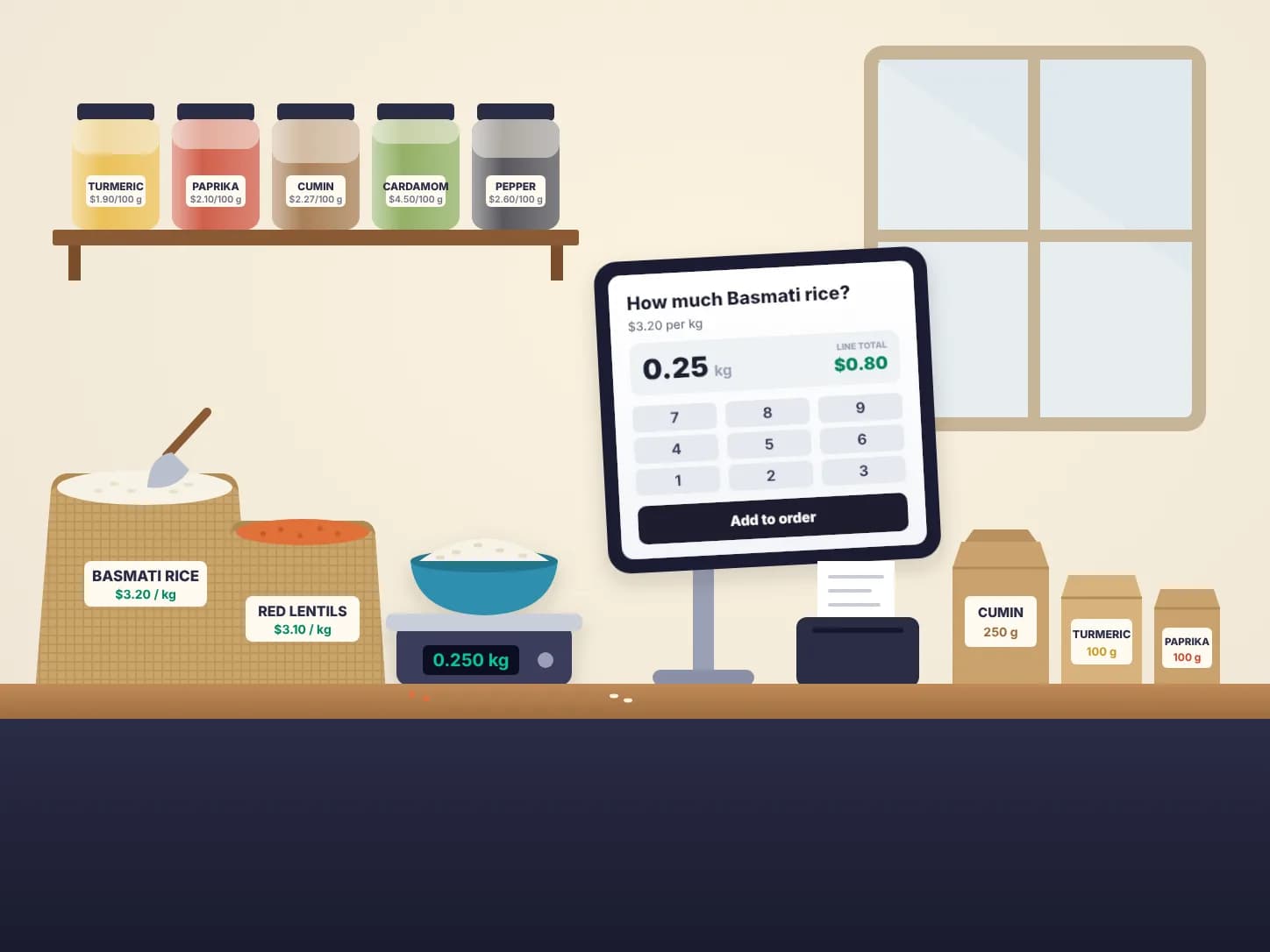
A customer at a spice shop asks for "a bit of cumin, maybe a hundred grams". You scoop, the scale says 104 g, and now you need a price, a receipt and a stock count that knows 104 g just left the jar. Selling by weight is simple with a scoop and a scale. It gets hard at the till.
How do you sell spices and grains by weight?
Price each loose product per kilo (or per pound), weigh what the customer wants, and charge the weight times the price. Your till should ask for the weight, work out the line total, and take that weight off stock. Count what's left in each jar every week or two, because loose goods always lose a little.
What price should I charge per kilo?
Start from what one kilo cost you, add an allowance for what you'll lose to spills and generous scooping, then add your margin. Spices usually carry a bigger margin than staple grains, because customers buy them in small amounts and compare them less.
Here are two worked examples:
| Step | Red lentils | Ground cumin |
|---|---|---|
| You buy | 25 kg sack for $45 | 5 kg bag for $55 |
| Cost per kilo | $45 ÷ 25 = $1.80 | $55 ÷ 5 = $11.00 |
| Allow 3% for loss | $1.80 ÷ 0.97 = $1.86 | $11.00 ÷ 0.97 = $11.34 |
| Margin | 40%: $1.86 ÷ 0.6 = $3.10 | 50%: $11.34 ÷ 0.5 = $22.68 |
| Price per kilo | $3.10 | $22.70 |
| Per 100 g, for the jar label | $0.31 | $2.27 |
The loss allowance matters more than it looks. Price the cumin without it and you charge $22.00 a kilo, then lose 3% of every jar. Over a month of 20 kg that is 0.6 kg of cumin, $6.60 at cost, gone without a sale. If margin and markup blur together, margin vs markup shows which to divide by, and the free pricing calculator does the sum.
Should I price per kilo or per 100 grams?
Put whichever your customers expect on the jar, but enter the price per kilo in your till. Most customers compare spices per 100 g, and $2.27 is easier to read than $22.70. Your till does the sums either way: 104 g at $22.70 a kilo is 0.104 × $22.70 = $2.36.
Avoid pricing cheap goods per gram in a till. Most tills show prices to the cent, so cumin at $0.0227 a gram shows as $0.02 on the screen and receipt, which looks wrong to the customer even when the total is right. Keep per-gram prices for things that cost several dollars a gram, like saffron or vanilla.
Loose or pre-packed: which sells better?
Most shops do both. Loose goods let customers buy exactly what they need and bring their own jars. Pre-packed bags are quicker at a busy counter and easier to sell online. They cost you a little more each, which the price should cover.
Take 250 g of ground cumin:
| Loose | Pre-packed bag | |
|---|---|---|
| Cumin at cost | 0.25 × $11.34 = $2.84 | $2.84 |
| Bag and label | — | $0.15 |
| Cost | $2.84 | $2.99 |
| Price at 50% margin | 0.25 × $22.70 = $5.68 | $2.99 ÷ 0.5 = $5.98, sold at $5.99 |
| Time at the till | Scoop, weigh, type | One tap or scan |
Pre-pack the two or three sizes that sell most, such as 100 g and 250 g, and keep everything else loose. Fill the bags during a quiet hour, not while a customer waits.
How do you keep stock of loose goods accurate?
Weigh what's left and compare it with what your records say. Loose goods always lose a little: spills, the extra few grams you let the scale tip over, samples for customers to smell, and moisture drying out of grains.
A loss of 2–3% a month is normal. More than that usually means one of three things:
- The scale isn't zeroed with the bag or bowl on it, so every sale includes the bag's weight for free.
- Weights are rounded up for customers: 104 g charged as 100 g, every time.
- Scoops aren't rung up, often a small top-up given to a regular.
The numbers add up. A shop selling 300 kg of loose goods a month at an average cost of $4 a kilo, losing 5% instead of 2%, loses an extra 9 kg: $36 a month, $432 a year, from goods that were paid for and never sold.
What should a POS do for a shop that sells by weight?
Ask the seller to show you these on the screen:
- Can I set a price per kilo, gram or pound?
- Does the till ask for the weight, and accept 0.085 for 85 g?
- Does it show the line total while I type the weight?
- Does stock go down by the weight sold, not by one?
- Can I restock by the sack and have the cost per kilo update?
- Can I record a shelf count in kilos, and see the difference?
- Does the receipt show the weight and the price per kilo?
- Can the same shop sell pre-packed bags by the piece?
- Does it keep selling when the internet drops?
- Does it charge per device, per month or a cut of each sale?
How do I sell by weight in Kasenso?
Kasenso sells by weight in retail mode. Add each loose product with Track stock on and Counted in set to kg, g or lb, and type its price per kilo. At the till, tapping it opens a keypad that asks How much Basmati rice?. Type the weight from your scale, such as 0.25, and the keypad shows the line total, $0.80 at $3.20 a kilo, before you tap Add to order.
From there:
- Stock goes down by 0.25 kg, and the product warns you when it reaches its Low at weight.
- The receipt shows 0.25 kg x $3.20 for each weighed line, and each line is rounded to the cent once, so the lines always add up to the total.
- Restocking a 25 kg sack adds 25 kg and re-averages the cost per kilo, so your reports show what each scoop really made.
- Count on the Stock screen takes the weight you measured and records the difference, and a write-off records a damp sack as a loss.
- Pre-packed bags are ordinary products counted in bag, with a size option for 100 g, 250 g and 500 g.
- Offline, the till keeps selling and syncs when the connection comes back.
The selling by weight guide walks through each step with the screens.
What Kasenso doesn't do yet
It is better to know before you switch:
- No scale connection. Kasenso doesn't read the weight from your scale. You read it and type it, which takes a second or two and works with any scale.
- No weight barcodes. Labels from a price-computing scale, with the weight inside the barcode, aren't read.
- Whole quantities online. The online store lists loose products, but customers order whole units, 1 or 2 kg rather than 0.25. Pre-packed bags work fully online.
- No choices on weighed items. Whole and ground cumin are two products.
Frequently asked questions
What is the best way to sell spices by weight?
Price each spice per kilo, label the jar per 100 g if customers prefer it, and weigh every sale on a zeroed scale. Use a till that asks for the weight, shows the line total and takes that weight off stock. Pre-pack your best-selling sizes, and weigh what's left in each jar every week or two.
How do I work out a price per kilo from a sack?
Divide what the sack cost by its weight, divide again by 0.97 to allow 3% for loss, then divide by one minus your margin. A 25 kg sack of lentils for $45 is $1.80 a kilo, $1.86 with the loss allowance, and $3.10 a kilo at a 40% margin.
Should I price spices per 100 g or per kilo?
Label the jar per 100 g if that is what customers compare, but enter the price per kilo in your till. $2.27 per 100 g is $22.70 per kilo. Per-gram prices in a till often show rounded to the cent, so $0.0227 a gram reads as $0.02.
How much stock loss is normal for loose goods?
Around 2–3% a month is normal for spices and grains sold loose, from spills, generous scooping, samples and moisture. More than that usually means an unzeroed scale, weights rounded up for customers, or scoops given away without being rung up. Weigh what's left regularly to find out.
Is it better to sell loose or pre-packed?
Both. Loose goods suit customers who want an exact amount or bring their own jars. Pre-packed bags are faster at a busy counter and easier to sell online, but cost more each for the bag and label. Pre-pack the two or three sizes that sell most and keep the rest loose.
Can Kasenso sell by weight?
Yes. In retail mode, set a product's unit to kg, g or lb and its price per unit. At the till, a keypad asks for the weight, shows the line total and takes that weight off stock. Restocks, shelf counts and write-offs all work in the same unit, and the receipt shows the weight and price per kilo.
Does Kasenso connect to a weighing scale?
No. Kasenso doesn't read weights from a scale or scan weight barcodes printed by one. You weigh on any scale and type the reading into the till's keypad. In many countries a scale used for selling by weight must be approved for trade, so check your local rules.
How much does Kasenso cost for a spice or grain shop?
Kasenso is free, with every feature included: selling by weight, stock counts, restocks, receipts, the online store and reports. There is no charge per device, no cut of your sales, and no credit card or contract. See the pricing page for details.
The short version
Price per kilo from what the sack cost, with room for the grams you'll lose. Weigh on a zeroed scale, type the weight into a till that does the sums, and weigh what's left often enough to notice when it stops matching.
Kasenso's selling by weight does the till part for free: a price per kilo, a keypad for the weight, and a stock count that goes down by exactly what you scooped.